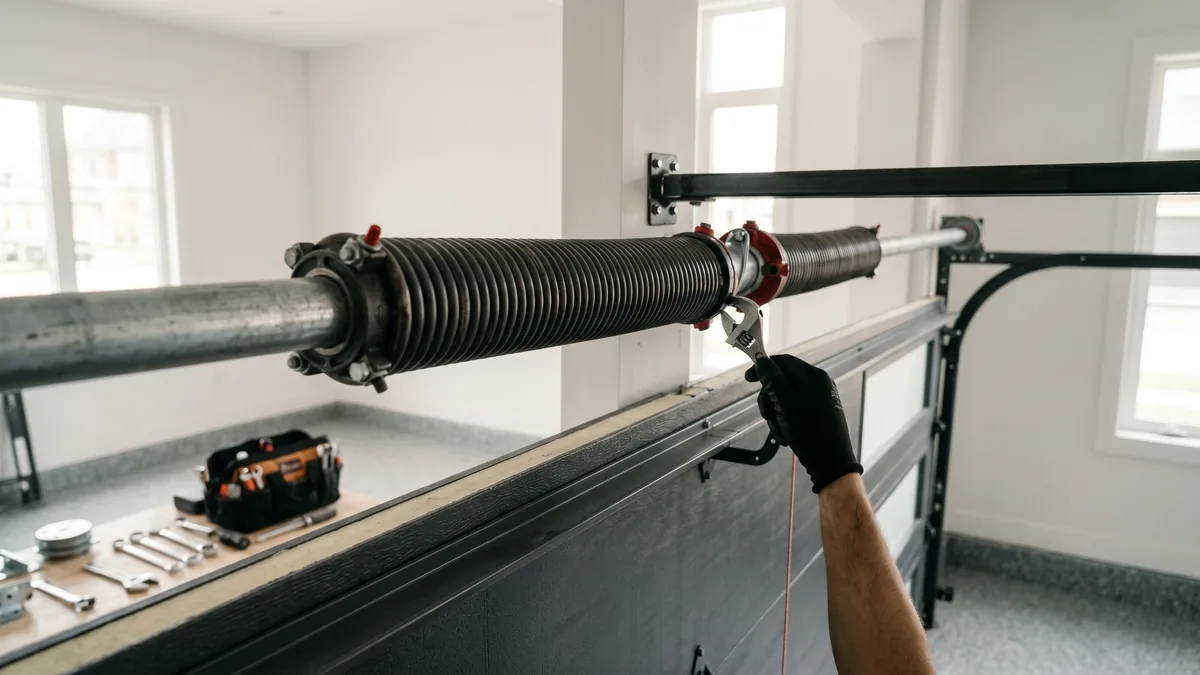
High-cycle torsion springs are commercial-grade counterbalance springs built to survive 25,000 to 100,000 open-and-close cycles, versus about 10,000 for a standard spring. They use larger-diameter wire over a longer barrel so the same lifting force is spread across more steel, slashing fatigue and downtime on busy loading-dock, shop, and warehouse doors. The right rating depends on how many times the door cycles per day — a high-traffic door that fails a standard spring in months can run for years on a properly sized high-cycle spring.
What Is a High-Cycle Spring?
A “cycle” is one complete open plus one complete close of the door. A torsion spring’s cycle life is the number of those cycles it can perform before metal fatigue causes it to break. A high-cycle spring achieves a higher rating — 25,000, 50,000, or 100,000 cycles — by using thicker wire wound over a longer length to produce the same lifting torque. More steel doing the same work means each coil flexes less per cycle, so the spring lasts far longer than a standard 10,000-cycle spring on the same door.
If you manage a warehouse, repair shop, fire hall, or distribution centre anywhere in Toronto and the GTA, you have probably watched a garage door spring snap at the worst possible moment — a truck waiting at the dock, a bay frozen shut, productivity bleeding away by the minute. This guide explains the high-cycle systems already installed on some commercial doors and how to service them. Royal Garage Doors has discontinued high-cycle upgrades and now installs standard torsion replacements at $160 per spring for commercial or multi-spring setups.
Cycle Ratings Explained: 10K vs 25K vs 100K
Every torsion spring is engineered around a target cycle count. The industry baseline — the spring most builders install on a new door to keep costs down — is rated for roughly 10,000 cycles. That number sounds large until you do the math against real commercial traffic. A spring rated for 10,000 cycles does not magically stop at 10,001; it is simply the point at which the manufacturer expects metal fatigue to start causing failures. Some die earlier, some last a bit longer, but the rating is your planning number.
The Door & Access Systems Manufacturers Association publishes the wire-size and cycle-life standards that reputable spring makers follow — you can read more at the DASMA technical resource library. The practical takeaway is simple: cycle rating is the single most important spec on a commercial spring, and it is the one most often ignored.
How Cycle Rating Translates to Real Years
The only way to know whether a spring rating is adequate is to compare it to how often your door actually opens. Count the cycles per day, then divide the rating by that number. The table below shows how dramatically the right rating changes service life for a door cycling 25 times a day — a modest number for an active commercial bay.
| Cycle Rating | Typical Use | Life @ 25 cycles/day | Life @ 50 cycles/day |
|---|---|---|---|
| 10,000 (standard) | Low-traffic residential | ~1.1 years | ~0.5 years |
| 25,000 | Light commercial / busy home | ~2.7 years | ~1.4 years |
| 50,000 | Active shop / dock door | ~5.5 years | ~2.7 years |
| 100,000 | High-traffic warehouse / fleet | ~11 years | ~5.5 years |
Look at the first row. A standard spring on a door that cycles 50 times a day — one delivery bay at a small Mississauga distributor — lasts barely six months. That is two failures a year, each one an emergency call and a stalled loading dock. Move to a 100,000-cycle spring and that same door runs for over five years on one spring set. This explains why existing commercial systems may have high-cycle springs; Royal now installs standard torsion replacements with scheduled inspections.
How High-Cycle Springs Are Engineered
The clever part of a high-cycle spring is that it does not lift any harder than a standard spring — it has to produce exactly the same balancing torque for the same door. What changes is how it produces that torque. A torsion spring’s force depends on its wire diameter, inside diameter, and length. To hit a higher cycle rating, a technician selects a larger wire size and then lengthens the spring to keep the lifting force correct.
Because the load is now distributed over more coils and more steel, the stress in each coil per cycle drops. Lower stress per cycle means slower fatigue, which means a higher cycle rating. It is the same principle behind why a thicker cable lasts longer under the same pull. The trade-off is cost and space: a high-cycle spring uses more steel and a longer torsion bar, so it is more expensive and needs adequate headroom above the door.
Oil-Tempered vs Galvanized Wire
Wire type also affects life. Oil-tempered steel is the commercial standard for torsion springs because it resists fatigue better and holds tension more consistently than galvanized wire, which is chosen mainly for corrosion resistance in damp or coastal environments. For most heated GTA warehouses, oil-tempered is the right call; for unheated, humid, or wash-down environments we weigh galvanized. We break down the trade-offs in our guide to oil-tempered vs galvanized springs, and the colour-coding system that identifies wire size in our spring colour codes reference.
How We Size a Commercial Spring System
There is no single “commercial spring.” Sizing is a calculation, not a guess, and getting it wrong leaves the door unbalanced — which destroys the spring, the opener, and the cables. When we quote a high-cycle system we measure and record five things before any spring leaves the truck.
- Door weight. We weigh the door (or calculate it from panel construction and glazing) because the spring must counterbalance that exact weight. Insulated and full-vision commercial doors weigh far more than they look.
- Door height. Travel distance sets how many turns the spring must wind, which feeds directly into the length calculation.
- Cable drum size and track radius. The drum and radius determine the moment arm and therefore the torque the spring needs to deliver at every point of travel.
- Daily cycle count. This decides the target rating — 25,000, 50,000, or 100,000 — so the spring matches how hard the door actually works.
- Available headroom. A longer high-cycle spring needs room above the door; tight headroom may require a multi-spring solution or a different mounting.
From those inputs we calculate the wire size, inside diameter, length, and number of springs that deliver perfect balance at the chosen cycle life. If you want to understand the measurements yourself, our walkthrough on how to measure torsion springs shows exactly what each dimension means.
One Spring or Two?
Most heavier commercial doors use two or more torsion springs rather than one. Splitting the lift across multiple springs has two big advantages. First, it lets each spring use thinner wire and reach a higher cycle rating for the same total torque. Second, if one spring breaks, the remaining spring still carries part of the load, so the door does not crash down and is often still movable — a real safety and continuity benefit on a busy dock. The trade-off is a higher parts cost, since you are buying two or more springs instead of one.
Commercial Spring Cost in the GTA
High-cycle upgrades are discontinued. At Royal Garage Doors, standard commercial and multi-spring setups are $160 per spring + tax. Here is how our current spring and related pricing breaks down:
| Service | Typical Cost (CAD) |
|---|---|
| Commercial / multi-spring (per spring) | from $160 + tax |
| Single residential torsion spring | $280 + tax |
| Double spring set (both springs) | $320–$460 + tax |
| Cables & brackets | $180–$260 + tax |
| Cables with bottom brackets | $260 + tax |
| TorqueMaster conversion to standard torsion | $530 + tax |
| Maintenance & tune-up | $120 + tax |
The service call is FREE with any repair — a $120 diagnostic fee applies only if you choose not to proceed after we assess the door. Every spring job is backed by our 1-year labour and 5-year hardware warranty. For the full, current list across every service, see our garage door pricing page, and for residential figures our garage door spring replacement cost breakdown.
Calculating the Real Cost of Downtime
Downtime planning still matters. With standard torsion replacements, commercial operators should document daily cycles, schedule inspections, and replace worn springs before a loading bay is blocked.
Servicing Existing High-Cycle Springs
High-cycle upgrades are discontinued. For an existing high-cycle system, record its rating and follow the manufacturer's inspection schedule; new replacement work uses standard torsion springs.
- Existing 100,000-cycle systems: record the rating and inspect on the manufacturer's schedule.
- Existing 50,000-cycle systems: service the full counterbalance assembly, including cables and drums.
- Existing 25,000-cycle systems: inspect based on actual daily use and current condition.
- New replacement work: Royal installs standard torsion springs sized to the door.
High-cycle upgrades are discontinued for residential and commercial doors. The same engineering that protects a warehouse door — thicker wire, lower stress per cycle — means a home door that just keeps working. If you are weighing a full door upgrade at the same time, our garage door replacement and overhead garage doors pages cover the options, and the commercial garage door repair team handles dock and warehouse work directly.
Don’t Forget the Rest of the Counterbalance System
A high-cycle spring only delivers its full life if the rest of the hardware is healthy. Worn cables, dry bearings, and tired rollers add friction that overworks even the best spring. When we service an existing high-cycle system we inspect and, where needed, refresh the cables and drums — see our garage door drum replacement and broken garage door cable resources — and the garage door roller replacement service for rollers. A matched, well-maintained system is what turns a 100,000-cycle rating into eleven real years of service.
The Bottom Line
Royal Garage Doors services existing high-cycle systems but does not sell or install new high-cycle upgrades. New work uses standard torsion springs at $160 per spring for commercial or multi-spring setups, supported by scheduled inspections.
Tired of Replacing Commercial Springs?
Royal Garage Doors services existing high-cycle systems but no longer sells or installs high-cycle spring upgrades. We install standard torsion springs for warehouses, shops, and loading docks across Toronto & the GTA. FREE service call with any repair, same-day appointments, and a 1-year labour / 5-year hardware warranty.
Call 437-265-9995