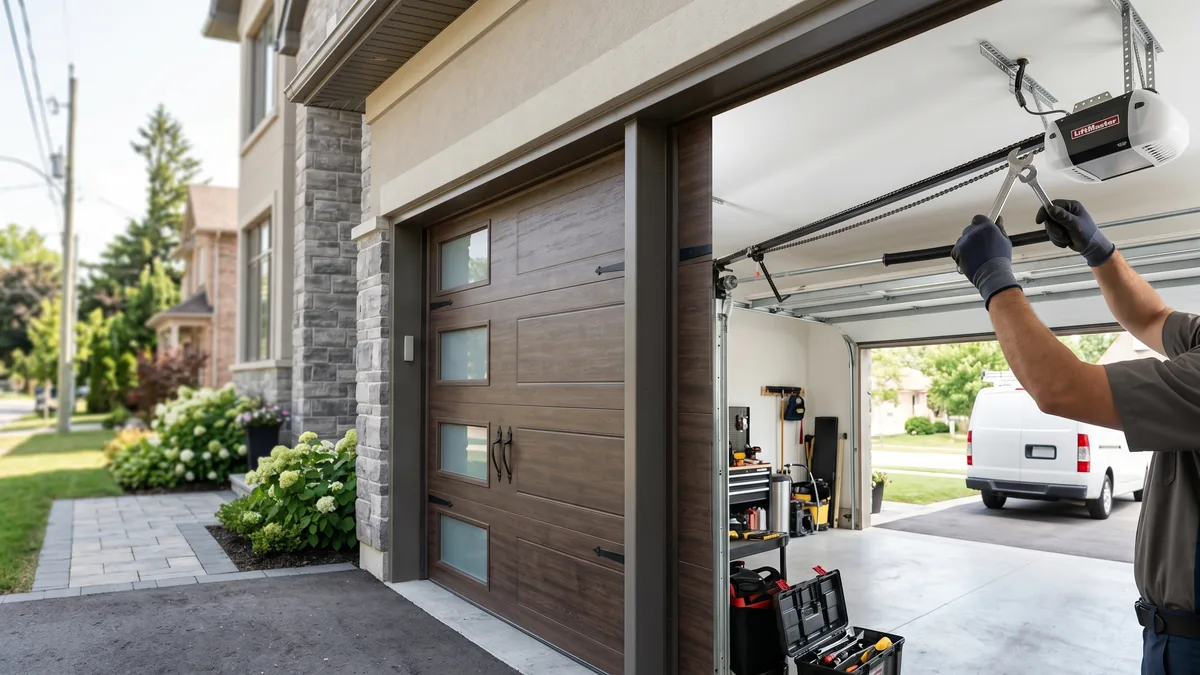
For a heavy or insulated garage door, choose a belt-drive opener with a DC motor rated at least 3/4 HP (or 1 HP/HPc for very heavy wood, full-view glass, or oversized double doors). A standard single insulated door is fine on 1/2 HP, but a 200–400+ lb double, solid-wood, or glass-and-aluminum door needs the higher torque, soft start/stop, and battery backup that DC belt-drive models deliver. Always confirm the springs are properly balanced before sizing the opener.
What Does "Heavy Door" Mean for an Opener?
A "heavy" door is any door whose residual weight — the small load the opener actually carries once the springs counterbalance the door — exceeds what a budget 1/2 HP opener can move smoothly. In practice this means insulated double doors, solid wood doors, full-view aluminum-and-glass doors, and doors with decorative overlays. The opener does not lift the whole door; it lifts the few pounds of imbalance plus overcomes friction and inertia.
Pairing the wrong opener with a heavy door is one of the most common premature-failure problems I see in Toronto and the GTA. People buy a heavy, beautiful insulated door, then bolt on the cheapest 1/2 HP chain opener — and three winters later the gears are stripped. This guide explains exactly how to match the opener to the door so it runs quietly and lasts 15+ years.
How Heavy Is Your Garage Door, Really?
Before you can pick an opener, you need a realistic sense of door weight. Weight is driven by three things: size (single vs. double), material (steel, wood, aluminum-and-glass), and insulation (single-layer pan vs. polyurethane-filled three-layer construction). Here is what we typically weigh in the field:
| Door Type | Typical Size | Approx. Weight | Suggested Opener |
|---|---|---|---|
| Single non-insulated steel | 8×7 / 9×7 | 100–130 lbs | 1/2 HP |
| Single insulated steel (3-layer) | 8×7 / 9×7 | 130–160 lbs | 1/2 HP DC |
| Double insulated steel | 16×7 | 200–250 lbs | 3/4 HP DC belt |
| Solid wood / carriage style | 16×7 | 250–350 lbs | 1 HP / 1.25 HPc |
| Full-view aluminum & glass | 16×7+ | 300–400+ lbs | 1 HP / 1.25 HPc DC belt |
The single biggest mistake homeowners make is assuming "insulated" means a marginal weight increase. A three-layer polyurethane double door can weigh nearly double a single non-insulated door — and that extra mass demands a stronger, smoother motor. If you are still choosing a door, our garage door replacement and door designer pages let you compare insulated models before you commit.
What HP Actually Means (and the HPc Trick)
Horsepower ratings on openers are confusing because they describe motor capacity, not lifting capacity. A 1/2 HP and a 3/4 HP unit can both technically "open" most doors — but the higher-rated motor does it with less strain, less heat, and a much longer service life on a heavy door.
HP vs. HPc (Newton-Force) Ratings
Some manufacturers (notably LiftMaster and Chamberlain) now publish HPc or Newton-force ratings instead of straight HP. HPc describes comparable lifting power of a DC motor relative to a traditional AC horsepower number. A "1.25 HPc" DC opener delivers lifting force comparable to a larger AC motor while drawing less current. For a heavy door, look at the force rating, not just the HP label.
AC Motor vs. DC Motor
AC motors are the older, cheaper standard — they start and stop abruptly, which jolts a heavy door. DC motors use variable speed control for a soft start and soft stop, run quieter, are more compact, and are the only motor type that supports battery backup. For any heavy or insulated door, a DC motor is the right call.
For a deeper breakdown of every rating tier, see our companion guide on what HP garage door opener you need. For the mechanical side of a worn-out motor, our garage door opener repair page covers diagnosis and replacement.
Drive Type: Belt vs. Chain vs. Jackshaft for Heavy Doors
The drive system — how the motor transmits force to the door — matters as much as horsepower when the load is heavy. Here is how the three main types perform under weight:
| Drive Type | Best For Heavy Doors? | Noise | Notes |
|---|---|---|---|
| Belt drive (DC) | Yes — top choice | Very quiet | Reinforced steel-core belt handles high torque smoothly; ideal under bedrooms |
| Chain drive | Capable but rough | Loud | Strong and durable but vibrates and is noisy on heavy doors |
| Jackshaft / wall-mount | Excellent | Quiet | Mounts on the wall beside the door; great for high-lift, heavy, or low-headroom installs |
| Screw drive (existing units) | Discontinued | Moderate | We service older units but replace failed systems with belt or chain drive |
Why Belt Drive Wins for Insulated Doors
A high-quality belt drive with a steel-reinforced (Kevlar or fiberglass-core) belt transmits the DC motor's torque to a heavy door without the rattle of a chain. Because insulated doors are usually chosen for living-space comfort — often with a room above the garage — the quiet operation of a belt matters. In our experience installing across Mississauga, Vaughan, and Oakville, belt-drive DC openers generate the fewest noise complaints on heavy doors.
When to Choose a Jackshaft (Wall-Mount) Opener
If your heavy door uses a high-lift or vertical-lift track (common with car lifts or 8′+ tall doors), a wall-mount jackshaft opener is often the best and sometimes the only option. It frees up ceiling space and handles weight extremely well. We cover the trade-offs in our side-mount vs. wall-mount opener comparison.
Fix the Springs First: The Most Important Rule
Here is the rule that saves homeowners hundreds of dollars: the opener does not lift your door — the springs do. A correctly balanced door, regardless of weight, leaves only a small residual load for the opener. If your springs are weak, broken, or undersized for a heavier new door, no opener — not even a 1.25 HPc unit — will survive long.
How to check balance yourself: pull the red emergency release cord to disconnect the opener, then lift the door by hand to about waist height and let go. A balanced door stays put. If it slams down or shoots up, the springs are wrong for the door weight — book a spring service before you spend on an opener. Single torsion spring replacement starts at $280 + tax and a full double-spring setup runs $320–$460 + tax on our pricing page.
Cold-Weather and GTA-Specific Considerations
Ontario winters add real engineering demands. Cold thickens grease, contracts metal, and can freeze a door's bottom seal to the floor — all of which increase the load the opener fights against on a January morning.
- Battery backup is near-essential: Ice storms and grid outages are common in the GTA, and a 250–400 lb insulated door is dangerous to lift by hand. Since 2019, California has mandated battery backup, and many LiftMaster and Chamberlain models sold in Canada now include it as standard. Choose a model with it.
- DC soft start matters more in cold: Abrupt AC starts shock a stiff, cold door. A DC soft start eases the heavy door into motion and reduces winter strain.
- Higher force headroom: A 3/4–1 HP opener on a door that only needs 1/2 HP in summer has reserve torque for cold-weather friction without tripping the safety reverse.
- Insulated door = climate control: If you heat your garage or have living space above, an insulated door's energy value (see Natural Resources Canada guidance on ENERGY STAR in Canada) is only worth it if the opener reliably seals it shut every cycle.
For UL 325 safety requirements that govern every residential opener's auto-reverse and entrapment protection, the International Door Association's safety resources are the authoritative reference. Every opener we install meets these standards.
Our Field-Tested Recommendations by Door
After 15+ years and thousands of installs across Toronto and the GTA, here is how I'd match openers to doors:
- Single insulated door (8×7 or 9×7): A 1/2 HP DC belt drive is plenty — quiet, efficient, and long-lived.
- Standard double insulated door (16×7, ~200–250 lbs): Step up to a 3/4 HP DC belt drive with battery backup. This is the sweet spot for most GTA homes.
- Solid wood, carriage-house, or decorative-overlay door: Use a 1 HP / 1.25 HPc DC belt drive. The extra mass and the overlay hardware justify the torque headroom.
- Full-view aluminum-and-glass door: Choose a 1 HP+ DC belt drive or a wall-mount jackshaft. These doors are heavy and expensive — do not under-power them.
- High-lift, low-headroom, or tall (8′+) doors: A wall-mount jackshaft opener is usually the best fit.
If you want a recommendation tailored to your exact door, our team can assess weight, balance, and track type on site. Explore the full range on our overhead garage doors page, or book an appointment and we'll spec the right opener for your door.
Not Sure Which Opener Fits Your Door?
Our IDEA Certified technicians will weigh and balance your door, then recommend the right HP and drive type — with a FREE service call on any installation across Toronto & GTA.
Call 437-265-9995