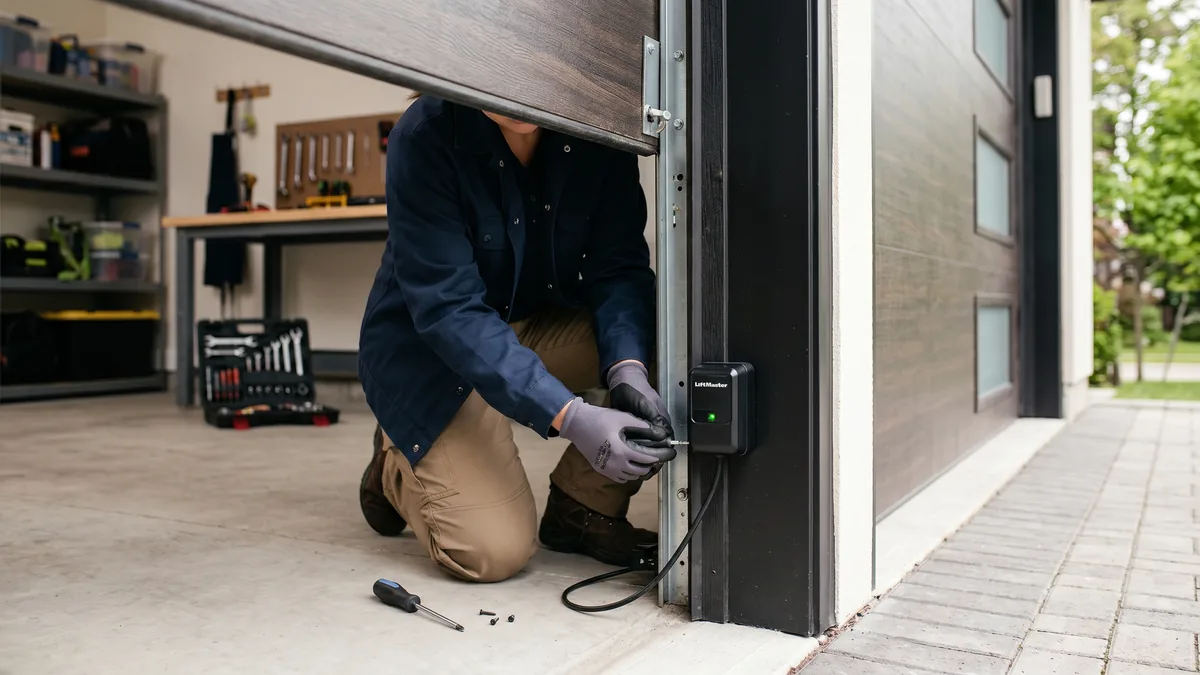
If your garage door won’t close and a light blinks, the two photo-eye safety sensors near the floor are not seeing each other. Most of the time the cause is a dirty lens, a bumped bracket, sunlight, or damaged wiring — clean both lenses and realign the receiving sensor until its light glows steady. If the light still won’t hold steady after cleaning, alignment, and a wiring check, the sensor has failed and the pair should be replaced. In the GTA, sensor replacement runs $120–$180 + tax.
What Is a Garage Door Photo-Eye Sensor?
A photo-eye is one of a matched pair of infrared safety sensors mounted about 6 inches above the floor on each side of the door opening. One eye (the sender) projects an invisible beam across the opening; the other (the receiver) detects it. If anything — a child, a pet, a bag of groceries — breaks the beam while the door is closing, the opener instantly reverses. This entrapment-protection system has been required on every residential opener in North America since 1993.
“My garage door starts to close, then stops and goes back up” is one of the most common service calls we get across Toronto and the GTA — and nine times out of ten the culprit is the photo-eye safety sensors, not the opener itself. The good news is that most sensor problems are alignment or cleaning issues you can fix in minutes. This guide explains how the sensors work, how to diagnose them, when a replacement is genuinely needed, and what it costs in the GTA.
Signs Your Photo-Eye Sensor Needs Attention
Photo-eye faults produce a very recognizable set of symptoms. If you see any of these, the sensors — not the motor — are almost always the place to start.
- The door reverses as soon as it nears the floor and goes back up, often repeatedly.
- The opener light blinks 10 times (on most LiftMaster and Chamberlain units) when you press the wall button — the standard sensor-fault code.
- One sensor LED is off or flickering. A healthy sender glows steady; a healthy receiver glows steady once aligned.
- The door only closes if you hold the wall button down (constant pressure bypasses the sensors), but won’t close from the remote.
- It closes fine at some times of day but not others — a classic sign of sunlight hitting the receiver.
Why Photo-Eye Sensors Stop Working
Before you buy a replacement sensor, it’s worth understanding the real causes. In my 15 years working on GTA doors, fewer than half of “bad sensor” calls actually need a new part — the rest are environmental or alignment problems.
1. Dirty or Fogged Lenses
Dust, cobwebs, road salt film, and winter condensation on the lens scatter the infrared beam. This is the number-one cause and the easiest to fix — a soft dry cloth usually restores function instantly.
2. Knocked-Out Alignment
The sensors sit low where they get bumped by bikes, snow shovels, garbage bins, and car bumpers. A nudge of a few degrees is enough to break the beam. The brackets also sag over time as the door vibrates.
3. Sunlight Interference
On east- and west-facing GTA garages, low morning or evening sun shining straight into the receiver can overwhelm the infrared signal and mimic a blocked beam. The door then refuses to close at sunrise or sunset but works fine at midday.
4. Damaged or Loose Wiring
Sensor wires are thin and often stapled along the track, where they get pinched, cut, or chewed by rodents. A corroded or loose terminal at the opener does the same thing. Wiring faults are the most common reason a sensor genuinely needs “replacing” when in fact the wire is the problem.
5. A Genuinely Failed Sensor
Sensors do eventually die — from a power surge, water intrusion, a cracked housing, or simple old age after 10–15 years. When cleaning, alignment, and wiring all check out but the light still won’t hold steady, the eye itself has failed and the pair should be replaced.
How to Diagnose Your Photo-Eye Sensor
Work through these steps in order. Most readers never get past step three because cleaning and alignment solve the problem.
- Read the LEDs. Look at both sensors. The sender (usually amber/yellow) should be steady. The receiver (usually green) should be steady when aligned and off or flickering when blocked or misaligned.
- Clean both lenses. Wipe each lens with a soft, dry microfiber cloth. Skip ammonia cleaners, which can haze the plastic.
- Realign the receiver. Loosen the wing nut, sight along the beam path, and gently tilt the sensor until the receiver LED glows steady. Retighten without nudging it.
- Check for clear line of sight. Move any bins, hoses, or stored items that might be clipping the beam.
- Test the wiring. Follow each sensor wire to the opener. Look for staple cuts, kinks, and loose terminal screws. Wiggle-test the connections while watching the LED.
- Rule out sunlight. If it only fails at sunrise/sunset, shade the receiver with your hand and try again — if it then closes, sunlight is your answer.
How to Replace a Photo-Eye Sensor
If diagnosis confirms a failed eye, replacement is a manageable job. Unlike springs and cables, photo-eye sensors carry no dangerous tension — just low-voltage wiring — so this is one of the safer DIY garage door repairs. Always unplug the opener first.
- Unplug the opener at the ceiling outlet so the door can’t cycle.
- Note the wiring. Each sensor has two wires — typically white and white-with-a-black-stripe. Photograph the existing connections at the opener.
- Remove the old sensors from their brackets and disconnect the wires (often a small twist-on cap or a quick-connect terminal).
- Mount the new pair at the same 6-inch height on each side, sender opposite receiver.
- Reconnect the wires to the matching opener terminals (polarity matters — match wire colours).
- Power up and align until the receiver LED is steady.
- Run the safety test below before trusting the door.
Most modern LiftMaster, Chamberlain, and Genie openers use compatible sensors, but always confirm your model. For brand-specific quirks see our guides on LiftMaster repair, Chamberlain repair, and Genie repair. The manufacturer’s own documentation, such as the official LiftMaster safety-sensor support pages, lists exact part numbers for your unit.
The Safety Reversal Test (Do This Every Time)
After any sensor work, verify the reversing system as the door safety standard DASMA recommends:
- Close the door from the wall button.
- As it closes, wave a cardboard box or broom handle through the beam.
- The door must reverse immediately and return fully open.
- Repeat two or three times. If it ever fails to reverse, stop and call a technician.
Repair, Realign, or Replace? A Quick Comparison
Not every sensor symptom needs a new part. Use this table to match your symptom to the right action.
| Symptom | Most Likely Cause | Fix | DIY? |
|---|---|---|---|
| Receiver LED dim or off | Dirty lens or misalignment | Clean & realign | Yes |
| Fails only at sunrise/sunset | Sunlight interference | Add sun shield / reposition | Yes |
| LED flickers when door vibrates | Loose wire or terminal | Secure wiring | Caution |
| No LED, wiring tests good | Failed sensor | Replace the pair | Caution |
| Intermittent, no clear pattern | Pinched/chewed wire | Rewire run | Pro |
| Door won’t reverse on the test | Sensor or opener logic board | Professional service | Pro |
Photo-Eye Sensor Replacement Cost in the GTA
Sensor work is one of the most affordable garage door repairs. A professional opener and sensor service includes a new matched pair, alignment, a wiring check, and the safety reversal test. Here is what related work typically costs across Toronto and the GTA:
| Service | Typical Cost (CAD) |
|---|---|
| Safety sensor repair / replacement | $120–$180 + tax |
| Sensor alignment within a tune-up | $120 + tax |
| New opener / motor (if board has failed) | from $600 + tax |
| Cables & brackets (if also worn) | $180–$260 + tax |
Royal Garage Doors offers a FREE service call with any repair; a $120 diagnostic fee applies only if you choose not to proceed. All work is backed by a 1-year labour and 5-year hardware warranty. See the full pricing page for every service, or read real customer reviews from GTA homeowners.
Local Same-Day Help
We carry universal and brand-matched sensors on every truck, so most sensor jobs are done same day. Find your local team in Toronto, Mississauga, Brampton, or Hamilton. If the opener logic board itself has failed, we also handle full door replacement and overhead door work, and our garage door company page covers everything we do.
Door Still Won’t Close After Cleaning the Sensors?
If the light keeps blinking after you’ve cleaned, aligned, and checked the wiring, the sensor has likely failed. Royal Garage Doors replaces and tests photo-eye sensors across Toronto & the GTA — FREE service call with any repair, same-day available.
Call 437-265-9995