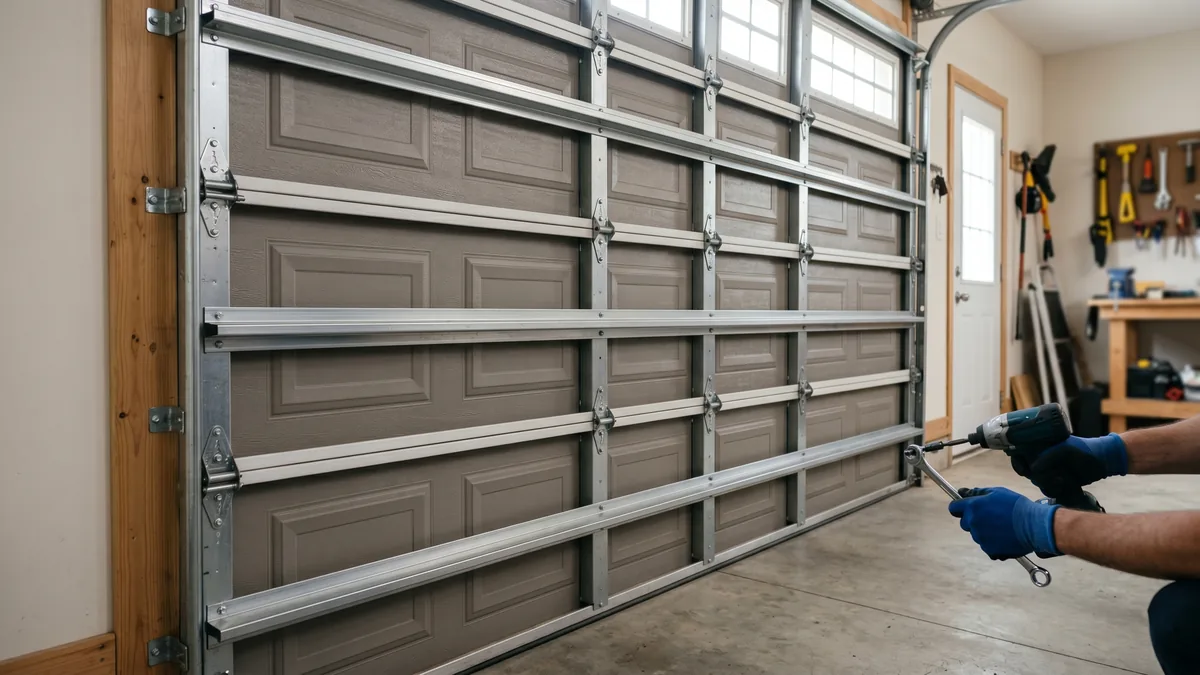
To reinforce a garage door for wind, bolt horizontal steel struts across each panel, upgrade to heavier hinges and reinforced rollers, and add a removable vertical wind-bracing kit before a storm. These steps stop the panels from bowing inward and the door from blowing out of its track. For an exposed, very wide, or badly under-built door, replacing it with a factory wind-load rated model is the stronger long-term fix. Spring, cable, and bottom-bracket work stays with a professional.
What Does Reinforcing a Garage Door Mean?
Reinforcing a garage door means adding structure and stronger hardware so the door can resist the inward and outward pressure that high wind puts on its large flat surface. This includes horizontal struts (U-bars) that stiffen each panel, removable bracing posts that tie the door to the floor and header, and upgraded hinges, rollers, end caps, and track brackets that keep the door locked in its tracks under load.
A garage door is the single largest opening in most GTA homes, and in a serious storm it is almost always the first thing to fail. When wind pushes a flimsy door inward and it buckles or blows out of its track, the pressure spike inside the garage can lift the roof and damage the whole house. The good news is that most existing doors can be meaningfully reinforced — and I will walk you through exactly how, step by step, with honest pricing for Toronto and the GTA.
Why Garage Doors Fail in High Wind
To reinforce a door correctly, it helps to understand how wind actually breaks one. Wind does not just blow against the door; it creates pressure differences on both faces. Gusts push the door inward, while the suction on the back of a passing storm can pull it outward. A wide, lightweight, single-skin steel door has very little to resist either force, so the panels flex, the rollers pop out of the track, and the door folds.
The most common failure points I see after windstorms across Mississauga, Brampton, and Toronto are:
- Panel bowing. Thin panels with no struts bend in the middle and crease permanently.
- Rollers leaving the track. Builder-grade short-stem rollers pull out when the door flexes, and the door jumps the track.
- Hinge tear-out. Light-gauge hinges rip at the screw holes when the panels work against each other.
- Track brackets pulling from the wall. If the vertical track is only screwed to drywall or thin framing, wind peels it away.
- Bottom bracket and cable failure. A door lifting and slamming in gusts shock-loads the cables and bottom brackets.
5 Ways to Reinforce a Garage Door for Wind
There is a spectrum of reinforcement, from a fifteen-minute hardware upgrade to a full wind-load rated replacement. Most homeowners combine two or three of the following.
1. Horizontal Struts (U-Bars)
A strut is a galvanized steel U-bar that bolts across the inside top of a panel, dramatically stiffening it against bowing. Many builder doors ship with a strut only on the top panel; adding one to each panel is the highest-value single upgrade for wind resistance. Struts also reduce flex that contributes to a door that shakes or vibrates on windy days.
2. Removable Vertical Wind-Bracing Kit
A wind-bracing kit is a set of vertical posts (aluminum or steel) that drop into a bracket anchored in the garage floor and lock into a bracket on the header above the opening. One brace is typical for a single door; two for a double. You install them when a storm is forecast and remove them afterward so you can still use the door day to day. They transfer wind load straight into the building structure rather than the panels.
3. Heavier Hinges, Reinforced Rollers & End Caps
Upgrading from thin builder hinges to heavier-gauge hinges, swapping short-stem rollers for longer-stem reinforced rollers, and adding stronger end caps keeps the door square and in its track under pressure. This pairs naturally with strut installation.
4. Track, Bracket & Anchor Upgrades
Reinforcement is only as strong as what the track is bolted to. Lagging track brackets into solid framing (not drywall), adding extra brackets, and confirming the door jambs are sound are essential. If the track itself is already bent, it should be corrected before adding load.
5. A Wind-Load Rated Replacement Door
For exposed rural lots, lakefront homes, or very wide double and commercial doors, the cleanest answer is a factory wind-load tested door engineered with built-in struts and heavier hardware. The Door & Access Systems Manufacturers Association publishes the wind-load testing standards manufacturers follow — see DASMA for the technical background. Explore options on our garage door replacement and overhead doors pages.
How to Reinforce Your Garage Door: Step by Step
Here is the method I use on a wind-reinforcement service call. Steps 1 through 4 are reasonable DIY; step 5 touches load-bearing hardware and is best left to a pro.
- Assess the door. Note the material, panel count, and width. Check which panels already have struts and whether the door catches wind badly (rattles, bows, or pulls out of the track).
- Add horizontal struts. Bolt a correctly sized galvanized U-bar across the inside top of each unstrutted panel, fastening into the panel stiles and end hinges per the manufacturer's pattern.
- Install a wind-bracing kit (if needed). Anchor the floor bracket into the slab and the header bracket into solid framing, then fit the vertical post. Test that it seats fully before relying on it.
- Upgrade hinges, rollers, and track anchors. Replace light hinges with heavier ones, fit reinforced rollers, and re-lag every track bracket into framing. Tighten all hardware.
- Verify the load-bearing system. Confirm the cables, bottom brackets, and spring balance are sound so the reinforced door stays in the track under gust load. This step is a technician's job.
- Seal the perimeter. Fresh side and top weather seal reduces wind-driven rattle and water intrusion during storms.
Retrofit vs. Wind-Load Rated Door
The biggest decision is whether to reinforce what you have or replace it. Use this comparison to decide which fits your situation.
| Factor | Reinforce Existing Door | Wind-Load Rated Replacement |
|---|---|---|
| Best for | Sound door, moderate wind | Exposed sites, wide/old doors |
| Wind resistance | Good (improved) | Best (factory tested) |
| Day-to-day use | Unchanged (braces removable) | Unchanged |
| Typical cost (GTA) | $180–$260 + tax in hardware | from $1,350 + tax installed |
| Installation time | Same day | Half a day |
| Warranty | 1yr labour on parts fitted | 1yr labour, 5yr hardware, lifetime panel |
Royal Garage Doors supplies and installs wind-conscious doors from multiple respected brands rather than pushing one line — whether that is a Clopay or Wayne Dalton model, a Garaga door, or a Steelcraft door — so the recommendation fits your opening and exposure, not a sales quota.
What Reinforcing a Garage Door Costs in the GTA
Reinforcement hardware falls in line with our standard bracket and hardware pricing, while a wind-load rated replacement is priced like any new door. Here is what to expect across Toronto and the GTA:
| Service | Typical Cost (CAD) |
|---|---|
| Hardware reinforcement (struts, hinges, rollers) | $180–$260 + tax |
| Cables & brackets (with bottom brackets) | $180–$260 + tax |
| Maintenance & balance tune-up | $120 + tax |
| Weather seal (size dependent) | $120–$260 + tax |
| Supply + install (8x7 single) | from $1,350 + tax |
| Supply + install (16x7 double) | $2,300 + tax |
Replacement doors run $1,350 (8x7), $1,500 (9x7), $1,650 (10x7), and $2,300 (15x7 or 16x7 double), with window inserts at +$125 per window. The service call is FREE with any repair or installation; a $120 diagnostic applies only if you choose not to proceed after assessment. For full, current numbers see our pricing page and installation cost guide, and read verified customer reviews before you book.
Storm Season Coming? Reinforce Before It Hits.
Royal Garage Doors fits struts, reinforced rollers, wind-bracing, and full wind-load rated doors across Toronto & the GTA — with FREE service calls on any repair and same-day appointments available. Serving Mississauga, Toronto, Brampton, and Hamilton.
Call 437-265-9995