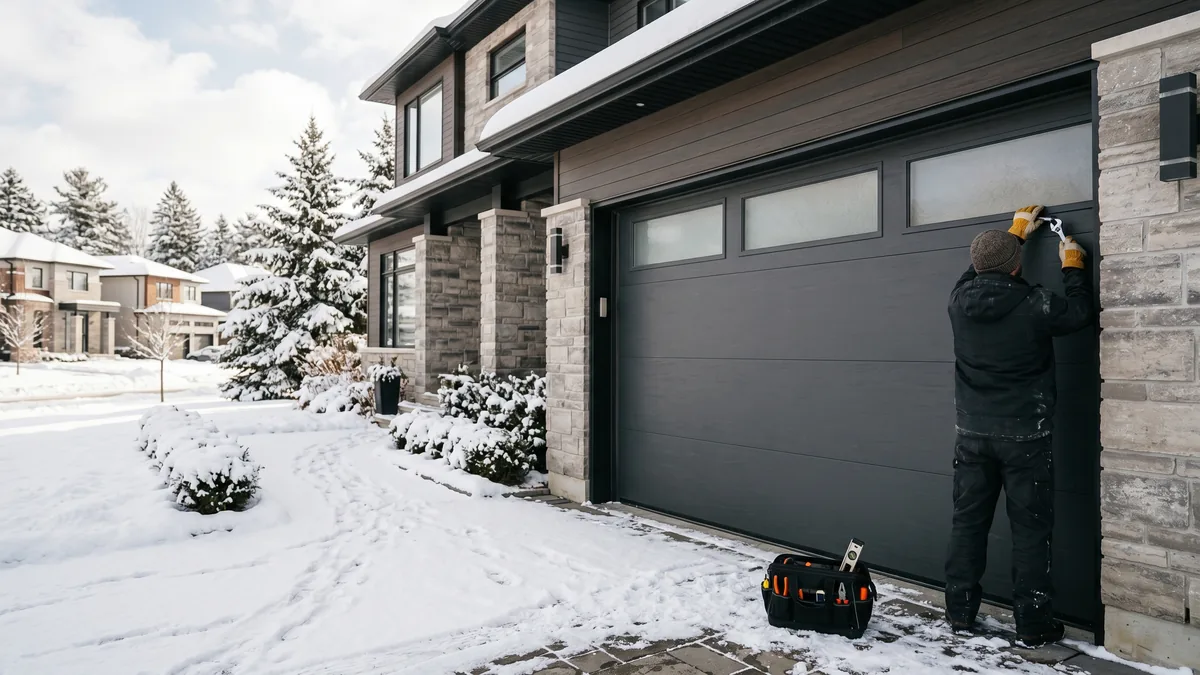
The best garage door for a Canadian cold climate is a polyurethane-insulated steel door with an R-value of at least R-16, a thermal break frame, and a flexible bottom seal rated for low temperatures. Polyurethane is foamed in place, bonding both steel skins for strength and far higher insulation than polystyrene. For an attached or heated GTA garage, a triple-layer steel-and-polyurethane door is the most reliable, energy-efficient choice for surviving freeze-thaw winters.
What Makes a Garage Door "Cold-Climate Ready"?
A cold-climate garage door combines four things: a high-R-value insulated core (usually foamed polyurethane), galvanized and painted steel skins that resist rust and salt, a thermal break that stops the metal frame from conducting cold straight indoors, and weather seals — bottom, side, and top — that stay flexible at −30°C. Miss any one and the door leaks heat no matter how high the R-value sticker reads.
Across Toronto and the GTA, the garage is the single largest opening in a home’s exterior wall — and during a Canadian winter it is where most homeowners lose comfort, heat, and money. After 15 years installing and servicing doors through Mississauga ice storms and Hamilton deep freezes, I’ve learned that the right cold-climate door is about far more than a big R-value number. This guide walks you through insulation type, R-value targets, materials, seals, and how the major brands stack up — so you buy a door that actually performs when it’s −25°C outside.
Why Insulation Matters More in Canada
An uninsulated single-layer steel door has an R-value of roughly R-0 to R-2 — barely better than an open window. In a GTA winter, that thin sheet of steel lets the garage drop to near-outdoor temperatures, which matters in three ways:
- Attached garages share a wall (and often a bedroom or bonus room) with your living space. A frozen garage pulls heat through that shared wall and the door above it, making rooms over the garage cold and expensive to heat.
- Water lines, water heaters, and stored liquids can freeze. Many GTA homes run plumbing through the garage ceiling or wall — an insulated door keeps the space above freezing.
- Cars, batteries, and gear last longer. A warmer garage means easier cold starts, less road-salt corrosion sitting frozen on the underbody, and a usable workshop in January.
The catch: R-value alone is marketing. A door can advertise R-18 and still leak badly if the perimeter seals are stiff, the frame has no thermal break, or the panels are warped. Real-world cold performance is the combination of core, frame, and seals working together.
Polyurethane vs. Polystyrene vs. No Insulation
There are three construction grades you’ll see on a showroom floor. For Canadian winters, the gap between them is enormous.
Single-Layer (Non-Insulated)
One sheet of steel, no core. Cheapest up front, lightest on the springs, and fine for a detached, unheated garage in a mild climate. In the GTA I only recommend these for a pure storage shed or where budget is the single deciding factor. R-0 to R-2.
Double-Layer (Polystyrene)
Steel skin plus a pre-cut polystyrene (EPS) foam board, sometimes with a vinyl back. Better than nothing, quieter, and moderately priced. But polystyrene is rigid board stock, so it leaves small air gaps at the edges and doesn’t bond the skins together. Typical real-world R-6 to R-10.
Triple-Layer (Polyurethane)
Two steel skins with polyurethane foam injected between them under pressure. The foam expands to fill every cavity and chemically bonds to both skins, which dramatically increases insulation and rigidity (so the door resists denting and wind). This is the gold standard for cold climates. Typical R-12 to R-18+ depending on thickness.
| Construction | Typical R-Value | Strength | Best For (GTA) |
|---|---|---|---|
| Single-layer steel | R-0 to R-2 | Low | Detached/unheated storage only |
| Double-layer polystyrene | R-6 to R-10 | Medium | Detached garage, mild use |
| Triple-layer polyurethane | R-12 to R-18+ | High | Attached & heated garages |
What R-Value Do You Actually Need?
Industry-standard testing of garage door thermal performance follows the DASMA TDS-163 method — you can read more from the Door & Access Systems Manufacturers Association (DASMA). For most GTA homes, here’s how I match R-value to how the garage is used:
| Garage Type | Recommended R-Value | Why |
|---|---|---|
| Detached, unheated | R-9 to R-12 | Comfort & freeze protection |
| Attached, unheated | R-12 to R-16 | Protects shared walls & rooms above |
| Attached, heated | R-16 to R-18+ | Lowest heat loss, best efficiency |
| Heated workshop / gym | R-18+ | Holds temperature in deep freeze |
Chasing R-20+ on a detached, unheated garage is usually wasted money — the heat loss through the slab and walls dwarfs the door. Spend that budget instead on better seals and a properly balanced spring system so the heavier insulated door opens smoothly all winter. For thinking through whether insulation pays off, our deep-dive on the cost to insulate a garage door and on insulated door energy savings are worth a read.
Best Materials for Canadian Winters
Royal Garage Doors supplies and installs every major material, and each has a place — the “best” depends on your priorities and budget. Here’s how they hold up to GTA freeze-thaw, road salt, and ice.
Insulated Steel (Most Popular)
Galvanized, primed, and baked-on painted steel wrapped around a polyurethane core. Strong, low-maintenance, rust-resistant, and the natural partner for foam insulation. For nine out of ten cold-climate homes this is what I recommend. Look for 24- or 25-gauge steel (lower number = thicker) on premium models.
Fiberglass & Composite
Dent-resistant and immune to rust, but cheaper fiberglass can become brittle in extreme cold. Modern composite overlays on a steel/foam core give you the wood look without the maintenance. A solid mid-to-premium choice if you park in a tight space and worry about dents.
Aluminum & Full-View Glass
Beautiful and modern, but aluminum conducts cold readily and glass is a thermal weak point. Choose only with insulated/Low-E glazing and a thermal break, and accept a lower effective R-value. Great for a heated, design-forward space; not ideal for a pure efficiency play.
Wood & Wood-Look
Stunning curb appeal, but real wood expands, contracts, and warps through freeze-thaw cycles and needs refinishing every few years. In our climate I steer most clients toward a steel door with a wood-grain or composite overlay — the carriage-house look with none of the seasonal headaches. See our comparison of carriage vs. traditional doors if style is a priority.
Seals & Thermal Breaks: The Hidden Half
This is where most “insulated” doors quietly fail in a Canadian winter. The core can be flawless, but if cold air pours around the edges, you’ve wasted the R-value.
- Bottom seal (astragal): A flexible T- or U-shaped gasket that compresses against the floor. Cheap PVC seals go rock-hard below freezing and crack; choose an EPDM rubber or thermoplastic seal rated for low temperatures. See our guide to the threshold vs. bottom seal debate.
- Side & top seals (weatherstripping): Vinyl or rubber stop-moulding along the jambs and header that blocks drafts at the perimeter. Read more in our side and top seal guide.
- Thermal break: A non-conductive strip built into the panel and/or frame that stops the steel from conducting cold straight through to the inside skin. Premium cold-climate doors include one; budget doors often skip it. Without a thermal break, the inside of the door can frost over even at high R-values.
- Weatherstripping at the garage-to-house door: Often overlooked — seal the passage door between the garage and the home too.
Replacing tired weather seals is one of the highest-value winter upgrades and runs $120–$260 + tax depending on door size and which seals you replace. It’s frequently the difference between a door that “feels insulated” and one that doesn’t.
Brand & Model Comparison for Cold Climates
We install and service multiple brands, and frankly several make excellent cold-climate doors — the right pick depends on budget, look, and availability. Below is a balanced view of how the major lines tend to position their top insulated models. Always confirm the exact R-value and seal spec on the specific model you choose.
| Brand | Top Insulated Construction | Cold-Climate Strength |
|---|---|---|
| Garaga | Triple-layer polyurethane, thermal break | Canadian-made, high R-values, strong seals |
| Clopay | Intellicore polyurethane | High R-values, wide style range |
| Wayne Dalton | Polyurethane & polystyrene options | Good value, broad lineup |
| Amarr | Triple-layer polyurethane | Strong insulated steel models |
| Steelcraft | Polyurethane-insulated steel | Canadian-made, value-focused |
For deeper, head-to-head reads see our Garaga garage doors review, Steelcraft review, Wayne Dalton vs. Amarr, and the brand-vs-brand Clopay vs. Wayne Dalton comparison. Whichever brand you pick, the cold-climate fundamentals are the same: polyurethane core, thermal break, and quality seals.
Cold-Climate Door Cost in the GTA
Here’s real, current pricing for a supplied-and-installed insulated steel door across Toronto and the GTA. Every install includes door panels, all hardware, weatherstripping, professional installation, old-door removal, and a safety check. The opener is sold separately (from $630).
| Door Size | Supply + Install (CAD) |
|---|---|
| 8×7 single | from $1,350 + tax |
| 9×7 single | $1,500 + tax |
| 10×7 single | $1,650 + tax |
| 15×7 or 16×7 double | $2,300 + tax |
| Window inserts | +$125 per window |
| Door only (delivery) | from $850 + tax |
Higher R-value polyurethane models, premium finishes, and full-view glass cost more. Every installation comes with a 1-year labour, 5-year hardware, and lifetime panel warranty (against rust-through perforation). The service call is FREE with any installation — a $120 diagnostic applies only if you choose not to proceed after assessment. For the complete, current list see our pricing page, or compare line items in our window cost breakdown and full tune-up cost guide. Planning a full swap? Start with garage door replacement and our overhead doors options.
My Recommendation for a GTA Winter
For an attached or heated garage, buy a triple-layer steel-and-polyurethane door at R-16 or higher, insist on a thermal break, and spend on low-temperature EPDM seals. For a detached, unheated garage, R-9 to R-12 with good seals is plenty — put the rest of the budget into a balanced spring system and a quiet opener. That combination outperforms a high-R-value door with cheap seals every single January.
Installation, Balance & the Opener
Two installation details make or break a cold-climate door:
- Spring sizing. A heavier insulated door needs a correctly matched torsion spring so it stays balanced and the opener isn’t overworked in the cold. A poorly balanced heavy door will fail prematurely.
- Opener choice. Cold thickens grease and stresses motors. A properly sized chain-drive, belt-drive DC, or jackshaft/wall-mount opener handles a heavy insulated door better. If you’re pairing a new door with a new opener, see opener repair and our brand setup guides for LiftMaster myQ and Chamberlain programming. We service every major opener brand: LiftMaster, Chamberlain, and Genie.
Royal Garage Doors handles supply, install, spring sizing, and opener setup as one job across Mississauga, Toronto, Brampton, and Hamilton. See why homeowners trust us on our reviews page, or learn more about our company.
Ready for a Door Built for Canadian Winters?
Get an insulated, polyurethane steel door sized, sprung, and sealed for GTA freeze-thaw — supplied and installed from $1,350 + tax with a FREE service call. Same-day quotes available across Toronto & the GTA.
Call 437-265-9995