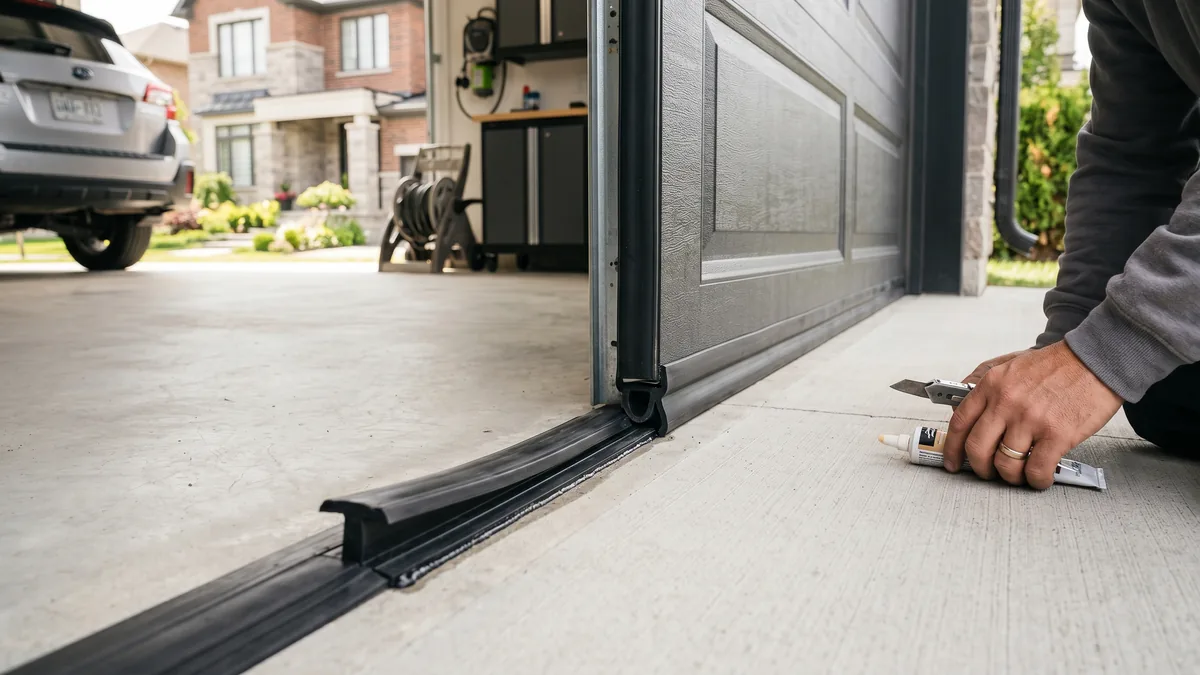
Neither is strictly "better" — they solve the same problem from opposite ends. A bottom seal attaches to the door and flexes down onto the floor; a threshold glues to the floor and raises a barrier up to the door. For keeping out water and driven snow, a threshold wins because it acts like a dam. For a quick, cheap draft and pest fix, the bottom seal wins. On uneven floors or flood-prone GTA garages, install both together for the tightest seal.
Threshold vs Bottom Seal: What's the Difference?
A bottom seal (also called an astragal or door sweep) is a flexible rubber or vinyl gasket clipped into a track on the bottom edge of the door, so it travels up and down with the panel. A threshold is a rigid-but-flexible rubber or aluminum strip bonded to the garage floor across the opening, so it stays put while the door lifts. One closes the gap by bending down; the other closes it by building up.
Every winter across Toronto and the GTA, I get calls about water pooling inside garages, drifting snow under the door, and that unmistakable cold draft creeping across the floor. The fix almost always comes down to two parts most homeowners confuse: the bottom seal and the threshold. They look similar and do a similar job, but they work in opposite directions — and choosing the right one (or both) depends on your floor, your driveway slope, and what you are trying to keep out.
How Each One Works
Before you can decide which is better for your garage, it helps to picture exactly where each part sits and how it makes its seal. They are not interchangeable — they attach to completely different surfaces.
The Bottom Seal (Astragal)
The bottom seal is a long strip of flexible rubber or vinyl that slides into an aluminum retainer fixed to the bottom edge of your garage door. The most common style is a U-shaped or T-shaped astragal that compresses flat as the door closes, conforming to small dips in the floor. Because it rides on the door, it seals the entire width of the opening and moves out of the way every time the door opens. It is the first line of defense against drafts, dust, leaves, and small pests — and it is the part that wears out first, especially in our freeze-thaw winters when rubber stiffens and cracks.
The Floor Threshold
A threshold is a low, raised strip — typically a vinyl or rubber profile with a crowned center — that you bond directly to the concrete floor along the line where the door meets the ground. When the door closes, its bottom seal (or even just the bottom edge) presses against the raised crown of the threshold. Because the threshold sits proud of the floor by roughly a half-inch to an inch, it forms a continuous ridge that blocks water from rolling in under the door and stops drifting snow from sneaking through. It does not move with the door; it is a permanent fixture on the slab.
The Key Mental Model
Bottom seal = the door reaches down to the floor. Threshold = the floor reaches up to the door. When you use both, they meet in the middle and overlap, which is why a door with a healthy bottom seal pressing onto a threshold is the most weather-tight setup you can buy.
Threshold vs Bottom Seal: Side-by-Side Comparison
Here is how the two stack up across the factors GTA homeowners actually care about. Notice that neither sweeps the board — each has clear strengths.
| Factor | Bottom Seal (Astragal) | Floor Threshold |
|---|---|---|
| Where it mounts | Bottom edge of the door | Garage floor / slab |
| Moves with door? | Yes | No (stays in place) |
| Blocks water / runoff | Fair | Excellent (acts as a dam) |
| Stops drifting snow | Good | Excellent |
| Blocks drafts & cold air | Excellent | Good |
| Keeps out pests & leaves | Excellent | Good |
| Best for uneven floors | Limited (gaps at dips) | Good (levels the contact line) |
| Typical lifespan | 5–10 years | 10+ years |
| Affected by tire traffic | No | Yes (you drive over it) |
| Relative cost | Lower | Higher |
Which Wins for Water and Snow?
The threshold wins here, and it is not close. If your driveway slopes toward the garage — common on older Toronto and Mississauga lots — rain and snowmelt run straight at the door. A bottom seal alone can be overwhelmed because it relies on the floor being flat and level at the exact point of contact. A threshold raises the contact line by half an inch or more, creating a small berm that turns water back toward the driveway. For anyone who has ever found a puddle creeping across the garage floor after a spring thaw, a threshold is the targeted fix.
Which Wins for Drafts and Pests?
The bottom seal wins for everyday draft and critter control. It seals the full width of the door, flexes into minor irregularities, and is the part that directly contacts the floor along the whole opening. When homeowners complain about cold air pouring across the slab and into the house, a hardened or torn bottom seal is the usual culprit. A fresh, pliable astragal restores the contact and is the cheaper, faster fix. Mice and insects also exploit a worn bottom seal long before they get past a threshold.
Which Wins on Cost and Effort?
The bottom seal wins on both. Replacing an astragal is a smaller part, a faster install, and a lower price. A threshold requires a clean, dry, level floor; proper adhesive; and dry weather to cure — not a given in a GTA winter. It is also something you drive over daily, so it must be installed dead straight to avoid catching tires or a snow shovel. For details on the rest of the perimeter, see our companion guide on the garage door side and top seal.
When to Use Each (or Both)
After fifteen years of sealing garages from Etobicoke to Hamilton, here is the decision tree I walk homeowners through.
Use a Bottom Seal Alone When…
- Your floor is reasonably flat and level at the door line.
- Your driveway slopes away from the garage (water already drains outward).
- Your main complaints are drafts, dust, leaves, or small pests — not standing water.
- You want the fastest, most affordable weatherproofing upgrade.
Add a Threshold When…
- Your driveway slopes toward the garage and water runs at the door.
- You get drifting snow piling against and under the door each winter.
- Your floor is uneven, wavy, or worn so the bottom seal cannot make full contact.
- You are finishing the garage (gym, workshop, storage) and want maximum protection.
Use Both Together When…
For most GTA garages that face real Canadian winters, the answer is both. The bottom seal compresses onto the raised crown of the threshold, giving you two independent layers of weatherproofing. If wind drives rain past the threshold, the bottom seal catches it; if the bottom seal hardens in deep cold, the threshold still holds back the bulk of the water and snow. The only rule is that the bottom seal must be in good shape and sized to gently compress against the threshold — not float above it or jam against it. A technician confirms that fit during installation.
Materials, Door Types & Compatibility
Not every seal fits every door, and the right material matters a lot in a climate that swings from +30°C to −25°C. Royal Garage Doors installs and services every major brand — Wayne Dalton, Clopay, Garaga, Steelcraft and more — so we match the seal to your specific door rather than forcing a one-size part.
Bottom Seal Profiles
- T-style and bulb (astragal): the most common residential profile, slides into a single or double aluminum retainer.
- U-shaped / loop: compresses flatter and conforms well to minor floor dips.
- Bead-style: older wood-door profile, stapled or nailed on rather than slotted into a retainer.
EPDM rubber outperforms cheap PVC in cold weather because it stays flexible well below freezing — a real advantage when a Toronto cold snap stiffens vinyl into a brittle strip that no longer seals.
Threshold Profiles
- Standard residential threshold: roughly 0.5–0.75 in. crown, fine for typical rain and light snow.
- Heavy-duty / high-crown threshold: up to 1+ in., for steep driveways and serious flood and snow exposure.
- Commercial threshold: reinforced for forklift and heavy vehicle traffic — see our commercial garage door services.
Cost to Seal Your Garage Door in the GTA
At Royal Garage Doors, weather sealing — bottom seals, side and top seals, and thresholds — runs $120–$260 + tax depending on your door size and which components you choose. A straightforward bottom seal replacement on a single door sits at the low end; a full threshold kit on a 16×7 double door lands toward the top. Here is a breakdown of the related work:
| Service | Typical Cost (CAD) |
|---|---|
| Bottom seal / side & top seals / threshold | $120–$260 + tax |
| Maintenance & tune-up (with seal check) | $120 + tax |
| Cables & brackets (if door sits unevenly) | $180–$260 + tax |
| Single torsion spring (if balance is off) | from $280 + tax |
| Panel replacement (if bottom panel is rotted/rusted) | $500–$1,000 + tax |
DIY threshold kits run roughly $40–$90 at GTA hardware stores and bottom seal stock is cheaper still, so the temptation to self-install is real. The catch is prep: the floor must be clean, dry, and level, the seal cut to exact length, and the adhesive given dry, above-freezing conditions to cure. Done in the wrong weather, a DIY threshold peels up by spring. Our weather seal work comes with a FREE service call when paired with any repair, and a 1-year labour warranty. See full numbers on our pricing page, or read what GTA neighbours say on our reviews page.
Don't Forget the Rest of the Perimeter
A bottom seal and threshold only handle the floor line. Cold air and water also sneak in at the sides and top of the door through worn stop-molding weatherstripping. If you feel drafts higher up, you likely need those replaced too. While we are sealing the door, we also check the balance, rollers, and cables — because a door that sits crooked will never seal evenly no matter how good the gasket is. If your door reverses or leaves a gap at one corner, read why in garage door reverses off the floor, and for energy questions see do insulated garage doors save energy.
The Verdict: Which Should You Choose?
If I had to give a one-line answer: start with a quality bottom seal, and add a threshold the moment water or snow is part of the problem. The bottom seal is the foundation — it is cheaper, faster, and handles the everyday drafts and pests. The threshold is the upgrade that conquers the harder problems of runoff, slope, drifting snow, and uneven floors. Together they are unbeatable, which is why most of our GTA weather-seal installs end up using both.
Bottom Line
Choose a bottom seal for drafts, pests, and budget; choose a threshold for water, snow, slope, and uneven floors; choose both for the tightest, most winter-proof seal a GTA garage can have. The right answer depends on your floor and driveway — which is exactly what a quick on-site assessment settles.
What a Professional Install Gets You
- The right diagnosis. We confirm whether you have a seal problem, a slope problem, or a door-balance problem before selling you a part.
- The right part. Cold-rated EPDM seals and a threshold crown matched to your driveway slope and door brand.
- A clean, lasting install. Proper floor prep, exact cuts, and adhesive cured in the right conditions so it does not peel by spring.
- A full perimeter check. Bottom, sides, top, plus a look at the balance, rollers, and cables while we are there.
Tired of Water, Snow & Drafts Under Your Door?
Royal Garage Doors installs cold-rated bottom seals and thresholds across Toronto & the GTA, with a FREE service call on any repair and same-day appointments available. We will tell you straight whether you need a seal, a threshold, or both.
Call 437-265-9995