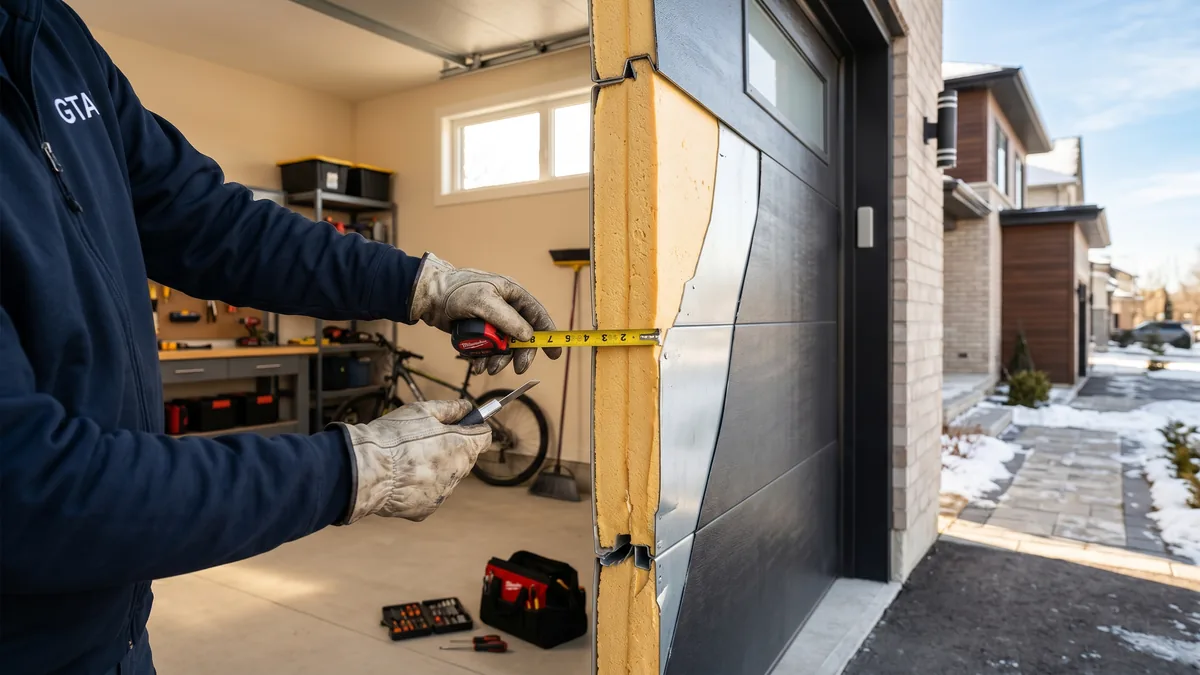
Yes — insulated garage doors save energy, especially in Toronto and the GTA. A door with a polyurethane foam core (R-12 to R-18) dramatically slows heat transfer through the largest opening in your home. The savings are largest for attached or heated garages that share a wall or ceiling with living space, where an insulated door stabilizes temperatures and trims winter heating costs. For a detached, unheated garage the energy savings are smaller, but you still gain a warmer, quieter, more usable space.
What Is an Insulated Garage Door?
An insulated garage door is a door whose panels contain a layer of foam — either rigid polystyrene board or injected polyurethane — sandwiched between steel skins. That foam layer resists the flow of heat (measured as R-value), so warmth stays inside in winter and outside in summer. A single-layer “pan” door is bare steel with no insulation; a two- or three-layer insulated door adds foam and an inner skin for thermal performance, strength, and quieter operation.
It is one of the most common questions I hear on quotes across Mississauga, Toronto, and the wider GTA: “Is the insulated door actually worth the extra money, or is it just marketing?” After 15 years installing doors through Ontario winters, my honest answer is that it depends on your garage — but for most attached garages, the energy, comfort, and durability gains add up. Here is exactly how insulated doors save energy, the R-values to look for, real numbers, and when the upgrade pays off.
How Insulated Garage Doors Save Energy
Your garage door is, by surface area, the single largest moving panel on your house — often 100 to 160 square feet of wall facing the outdoors. An uninsulated steel door is essentially a giant cold plate: in a –15°C GTA cold snap, that bare steel conducts heat straight out of the garage. Insulation interrupts that flow in three ways.
1. It Slows Conductive Heat Loss
The foam core resists conduction — the direct transfer of heat through the door material. The thicker and denser the foam (and the higher its R-value), the slower heat escapes. This is the headline benefit and the reason an insulated garage stays noticeably warmer than one with a bare steel door.
2. It Reduces Air Leakage
Insulated doors are built with thermal breaks and tighter-fitting sections, and they are almost always paired with better perimeter and bottom weather seals. Stopping cold-air infiltration around the edges is just as important as the foam itself — a draughty seal can undo a lot of an R-18 door’s benefit. We cover sealing in detail in our guides to side and top seals and the threshold vs. bottom seal decision.
3. It Buffers the Rooms Around the Garage
If you have a bedroom over the garage or a living space sharing a wall, that adjacent room loses heat to a cold garage all winter. An insulated door keeps the garage warmer, which means the shared wall or floor stays warmer, which means your furnace works less to heat the rooms next door. This indirect saving is where most of the real dollar value shows up.
R-Value Explained: What Number Do You Actually Need?
R-value measures resistance to heat flow — higher is better. But the garage-door industry uses it loosely, so it pays to understand what the number means before you compare quotes.
What Is R-Value?
R-value is the rating of how well a material resists conductive heat transfer. A higher R-value means slower heat loss. For garage doors, the figure usually refers to the insulated section of the door, not the whole assembly — so real-world performance also depends on weather seals, how well the door fits the opening, and whether the garage walls and ceiling are insulated too.
For our climate, here is the practical guidance I give GTA homeowners:
- Detached, unheated garage: R-6 to R-9 is plenty. The door mainly blocks wind and keeps the space milder.
- Attached, unheated garage (most GTA homes): R-9 to R-12 is the sweet spot for comfort and protecting the rooms next door.
- Attached and heated, or a room above the garage: R-12 to R-18 pays for itself fastest, because you are actively heating the space.
Industry standards for measuring and labelling garage door R-value are set by DASMA, the Door & Access Systems Manufacturers Association — you can read their technical data sheet on DASMA.com. For broader home-energy guidance in Canada, Natural Resources Canada’s ENERGY STAR Canada program is a useful reference.
Polyurethane vs. Polystyrene Insulation
There are two ways manufacturers put foam in a door, and the difference matters for both energy savings and durability.
| Feature | Polystyrene (EPS board) | Polyurethane (injected foam) |
|---|---|---|
| Typical R-value | R-6 to R-9 | R-12 to R-18+ |
| How it is installed | Rigid board slotted between skins | Liquid foam injected, expands & bonds |
| Air gaps / voids | Some gaps possible | Fills every cavity, no voids |
| Door rigidity & strength | Moderate | High (foam bonds to steel) |
| Noise / quietness | Quieter than bare steel | Quietest option |
| Dent resistance | Good | Best |
| Relative cost | Lower | Higher |
Polystyrene is rigid foam board cut to fit and slotted between the door’s steel skins. It is affordable and a clear upgrade over a bare door, but it can leave small air gaps and offers a lower R-value per inch.
Polyurethane is liquid foam injected into the panel where it expands and chemically bonds to the steel skins, filling every void. That bonding makes the door more rigid, far quieter, more dent-resistant, and significantly better insulated in a slimmer panel. For GTA winters I recommend polyurethane whenever the budget allows — the energy and durability gains are real. Royal Garage Doors installs quality insulated doors from multiple respected manufacturers, so you are not locked into one brand. If you are weighing brands, our reviews of Garaga, Steelcraft, Clopay vs. Wayne Dalton, and Wayne Dalton vs. Amarr walk through the insulation options each line offers.
Real Numbers: How Much Can You Actually Save?
Be wary of any installer who promises a precise dollar figure — savings depend on whether your garage is heated, how well the rest of it is insulated, your home’s layout, and the size of the door. That said, here is a realistic picture for the GTA.
If your garage is unheated and detached, swapping a bare steel door for an insulated one will not move your utility bill much directly, because you weren’t paying to heat the space. The win is comfort: the garage stays 5 to 10°C warmer on a cold day, pipes and stored items are protected, and the door is much quieter.
If your garage is attached with living space above or beside it, the math changes. An insulated door reduces heat loss from those adjacent rooms, so your furnace cycles less. Across a full Ontario heating season many homeowners see a modest but genuine reduction in heating costs — and the comfort difference in that bedroom over the garage is immediate and obvious. If the garage is actively heated (a workshop or home gym), the savings are largest because every BTU you generate now stays in the room far longer.
| Garage Type | Direct Energy Saving | Main Benefit |
|---|---|---|
| Detached, unheated | Low | Warmer, quieter, protects stored items |
| Attached, unheated | Moderate | Warmer adjacent rooms, less furnace load |
| Attached, room above/beside | Moderate–High | Noticeably warmer living space, lower bills |
| Attached & heated | High | Heat stays in; lowest cost to keep warm |
Energy Savings Aren’t the Only Payoff
Even when the heating-bill savings are modest, insulated doors earn their keep in other ways that matter to GTA homeowners:
- Much quieter operation. The bonded foam in a polyurethane door deadens the rattle and vibration of bare steel — a big deal if there’s a bedroom above the garage.
- Stronger and more dent-resistant. The foam stiffens the panels, so they shrug off backed-into bumps and stray hockey pucks better than a single-layer door.
- Longer lifespan and fewer repairs. A rigid, well-built insulated door puts less strain on the opener, rollers, and springs. See our how long a garage door lasts guide.
- Better for cold climates. Insulated steel handles freeze-thaw cycles and road salt better — more in our roundup of the best garage doors for cold climates.
- Resale appeal. An insulated door is a recognized feature that buyers and home inspectors value.
What an Insulated Garage Door Costs in the GTA
Here is current supply-and-install pricing from Royal Garage Doors. Every price includes door panels, all hardware, weatherstripping, professional installation, old-door removal, and a safety check. The opener is sold separately (from $630 + tax), and the service call is FREE with any installation.
| Insulated Door (Supply + Install) | Price (CAD) |
|---|---|
| Single 8×7 | from $1,350 + tax |
| Single 9×7 | $1,500 + tax |
| Single 10×7 | $1,650 + tax |
| Double 15×7 or 16×7 | $2,300 + tax |
| Window inserts (per window) | +$125 |
| Door only — delivery | from $850 + tax |
Warranties on installed doors are 1 year labour, 5 years hardware, and a lifetime panel warranty against rust-through perforation. For the complete, up-to-date list see our pricing page, or compare scenarios in our cost to insulate a garage door and installation cost guides. Adding glass? Our garage door window cost guide breaks down the insert pricing.
Should You Upgrade, or Just Reseal?
If your existing door is structurally sound but the garage feels draughty, you may not need a full replacement at all. The most common reason a sound door leaks heat is worn or missing weather seals — and replacing those is a fraction of the cost of a new door.
- Door is old, dented, single-layer, or rusting: upgrade to an insulated door. You gain energy savings, strength, and quiet all at once.
- Door is solid but draughty: start with new bottom, side, and top weather seals ($120–$260 + tax) before spending on a replacement.
- Panels damaged but frame is fine: sometimes a panel replacement ($500–$1,000) is the smarter fix.
- Door binds, shakes, or feels heavy: get the balance, rollers, and springs checked first — a tune-up runs $120 + tax.
Not sure which camp you’re in? A free assessment sorts it out fast. You can also explore our garage door replacement and overhead doors service pages, and if you’re comparing layouts, our double vs. two single doors guide is worth a read.
The Verdict
For the typical GTA home with an attached garage, an insulated garage door is worth it. The energy savings are real (largest when the garage is heated or has living space above), and they come bundled with a quieter, stronger, longer-lasting door. If your current door is fine but draughty, reseal first — it’s the cheapest win. When you’re ready to replace, choose a polyurethane core in the R-12 to R-18 range and make sure the springs are sized for the heavier door.
Thinking About an Insulated Door?
Get a free, no-pressure assessment of your garage and a same-day quote on an insulated door sized and sealed for GTA winters. Royal Garage Doors installs quality doors across Toronto, Mississauga, Brampton, Hamilton, and the wider GTA — FREE service call with any installation.
Call 437-265-9995