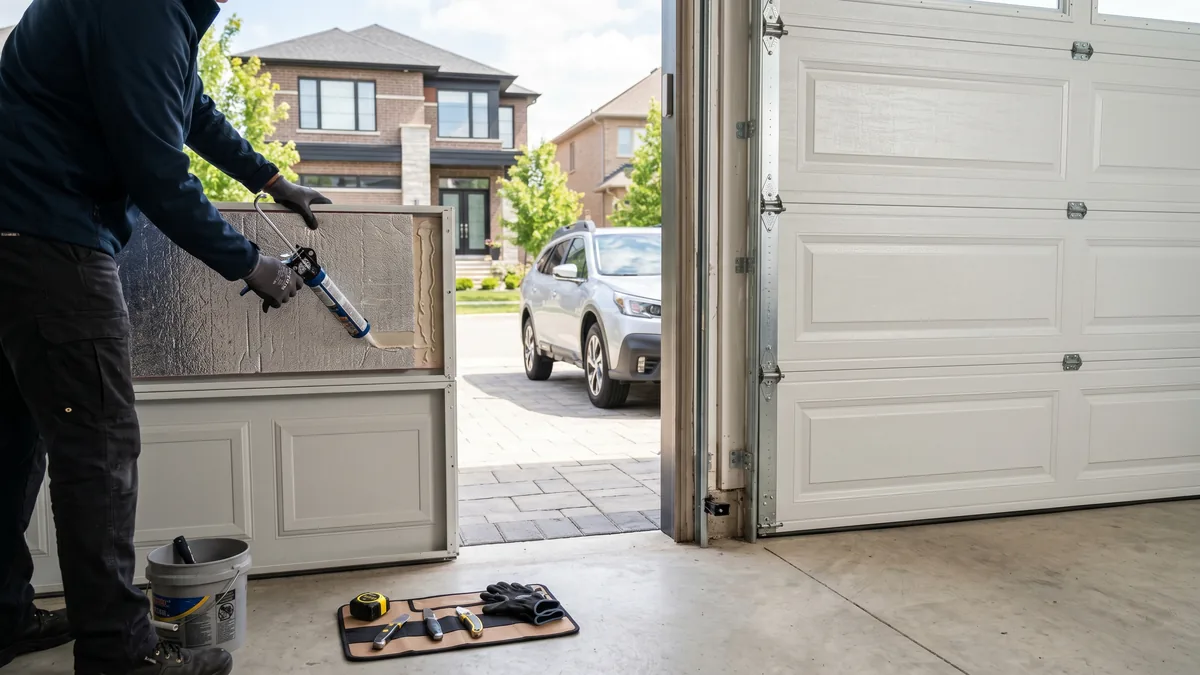
If your existing steel door is in good shape, a DIY insulation kit ($60–$150) takes the chill off an attached garage and raises it from about R-0 to R-4 to R-8. If the door is old, dented, rusting, or already failing, a new factory-insulated door (from $1,350 + tax in the GTA) reaches R-9 to R-18, seals the panel joints, and replaces worn hardware at the same time. Match the upgrade to the condition of your door, not just the price.
What Is a Garage Door Insulation Kit?
A garage door insulation kit is a retrofit product — usually rigid foam (polystyrene) boards, foil-faced batts, or a reflective laminate — that you cut to size and fit into the recessed panels of an existing single-layer steel door. It is held in place with retainer clips, adhesive, or a friction fit. The goal is to add a layer of thermal resistance to a door that left the factory with none, without the cost of replacing the whole door.
Across Toronto and the GTA, a lot of homeowners ask me the same thing every fall: should I just buy an insulation kit from the hardware store, or is it time for a new insulated door? Both are legitimate upgrades, and the right answer depends entirely on the condition of your current door, how you use the garage, and the temperature swings of a Canadian winter. Here is the honest, balanced breakdown I give my own customers.
Insulation Kit vs New Insulated Door: Side by Side
The fastest way to see the trade-off is a direct comparison. A kit is a cheap, fast, partial upgrade to a door you keep; a new door is a complete, longer-lasting upgrade that also fixes everything else that has worn out. Neither is universally "better" — they solve different problems.
| Factor | Insulation Kit (Retrofit) | New Insulated Door |
|---|---|---|
| Typical cost | $60–$150 DIY | from $1,350 + tax installed |
| Effective R-value | R-4 to R-8 | R-9 to R-18+ |
| Panel-joint sealing | No (panels stay open) | Yes (thermal breaks) |
| Installation time | 2–4 hrs DIY | Half day, professional |
| Fixes worn hardware? | No | Yes (new rollers, springs, seals) |
| Adds door weight | +10 to +30 lbs | Engineered & balanced |
| Curb appeal | No change | New look & finish |
| Lifespan | Limited by old door | 15–30 years |
| Warranty | None on the door | 1yr labour, 5yr hardware, lifetime panel |
Understanding R-Value (and Why the Numbers Mislead)
R-value measures resistance to heat flow — higher is better. A bare single-layer steel door is effectively R-0 to R-1. But R-value on a garage door is a bit of a marketing minefield, so it pays to know what the number actually means before you compare a kit to a new door.
What the R-value covers
Manufacturers quote R-value at the thickest point of the panel, not the whole door assembly. A door rated "R-16" does not keep your garage 16 times warmer than an R-1 door — air leakage around the perimeter, at the panel joints, and under the bottom seal often matters more than the panel core. The industry trade body DASMA publishes a standard test method for calculating door R-value; for the official background, see the DASMA technical resources.
Where a kit falls short
A retrofit kit insulates the flat panel sections but does nothing for the gaps between panels, the stiles, or the perimeter. A factory door is built as a sealed sandwich — two steel skins with polystyrene or polyurethane foam injected between them — plus thermal breaks and integrated weatherstripping. That is why a new R-12 door usually outperforms a kit-upgraded door of similar panel R-value in real GTA winters. For more on the dollars-and-cents side, our guide to the cost to insulate a garage door and the energy savings from an insulated door dig deeper.
When a DIY Insulation Kit Makes Sense
A kit is the smart, budget-friendly choice in plenty of situations. I recommend one when:
- Your door is newer and structurally sound. No rust-through, no cracked panels, no failing rollers — the door has years of life left and just lacks insulation.
- You want comfort, not perfection. A kit can drop the worst of the summer heat and winter chill in an attached garage used as a gym, workshop, or mudroom.
- Budget is tight this season. Spending $100 now and a new door later is a reasonable staged plan.
- The garage shares a wall or ceiling with living space. Even modest insulation here improves comfort in the rooms next to and above the garage.
The catch is weight. Adding foam, batts, or laminate puts 10 to 30 extra pounds on a door whose torsion spring was sized for a bare panel. That is where most DIY jobs go wrong.
The 2-Minute Balance Test After a Kit
- Close the door fully, then pull the red emergency release cord to disconnect the opener.
- Lift the door by hand to about waist height and let go.
- A balanced door stays roughly in place. If it slams down or feels much heavier than before, the spring is now undersized for the added weight.
- Re-engage the opener. Book a balance and tune-up service ($120 + tax) before the imbalance wears out your opener or breaks a cable.
When a New Insulated Door Is the Better Buy
Sometimes spending $100 on a kit is throwing good money after bad. A new factory-insulated door is the smarter investment when:
- The door is 15+ years old or showing rust, dents, or cracked panels. Insulating a tired door just delays the inevitable replacement.
- You are already facing repairs. If you need panel replacement, new rollers, or a broken spring fixed anyway, the cost gap to a full new door shrinks fast.
- You want quieter operation. A bonded polyurethane door is dramatically quieter — a real benefit when bedrooms sit above the garage.
- Curb appeal and resale matter. A new door is consistently one of the highest-return home improvements, and a fresh insulated door updates the whole front of the house.
- You live with harsh winters. For the coldest GTA microclimates, see our picks for the best garage doors for cold climates.
New Insulated Door Pricing in the GTA
Royal Garage Doors supplies and installs factory-insulated steel doors across Toronto, Mississauga, Brampton, Hamilton and the wider GTA. Supply-and-install pricing includes the insulated panels, all hardware, weatherstripping, professional installation, old-door removal, and a safety check. The opener is sold separately (from $630 + tax).
| Insulated Door Size | Supply + Install (CAD) |
|---|---|
| 8×7 single | from $1,350 + tax |
| 9×7 single | $1,500 + tax |
| 10×7 single | $1,650 + tax |
| 15×7 or 16×7 double | $2,300 + tax |
| Window inserts | +$125 per window |
| Door only (delivery) | from $850 + tax |
Every new-door install carries a 1-year labour warranty, 5-year hardware warranty, and a lifetime panel warranty against rust-through perforation. For the complete, current price list see our pricing page, the installation cost guide, or browse garage door replacement and overhead garage door options.
The Real Cost Comparison Over Time
On day one, the kit wins on price by a wide margin. But the comparison changes when you factor in lifespan and the repairs a kit does not address.
| Scenario | Insulation Kit Path | New Door Path |
|---|---|---|
| Upfront cost | ~$100 DIY | from $1,350 installed |
| Possible spring re-balance | +$120 | Included |
| Old hardware still wears out | Yes — future repairs likely | New — covered by warranty |
| Comfort gain | Moderate | High |
| Adds home value | Minimal | Strong ROI |
For a sound, newer door, the kit is genuinely cost-effective. For an aging door that will need a spring, cable, or panel within a year or two, paying for a kit now plus repairs plus an eventual replacement usually costs more than going straight to a new insulated door. If you are weighing one big door versus two, our double vs two single doors comparison helps too.
The Bottom Line
Choose an insulation kit if your door is in good condition and you want a quick, low-cost comfort boost — just run the balance test afterward. Choose a new insulated door if your door is old, damaged, or already needs repairs, if you want quieter operation, or if you want the warranty, curb appeal, and full R-9-to-R-18 performance that no retrofit can match.
Installing a Kit Right (If You Go DIY)
If you decide a kit is the right call, a few details separate a job that lasts from one that sags and falls out by spring:
- Measure each panel individually. Garage door panels are not always identical — cut foam pieces about 1/4 inch oversized for a snug friction fit.
- Use the supplied retainer clips or pins. Adhesive alone tends to release in summer heat. Mechanical retainers hold the insulation against the panel reliably.
- Keep insulation clear of the hinges and rollers. Foam pressing into moving hardware causes binding and noise — if your door starts to reverse or behave oddly, check for interference first.
- Refresh the weatherstripping. A kit does nothing if cold air pours in under the bottom seal or around the sides. Pair it with new side and top seals or a bottom seal upgrade for the biggest comfort gain.
- Re-test the balance and lubricate. Confirm the door still balances, then lubricate rollers and hinges so the added weight does not accelerate wear.
Insulate, Rebalance, or Replace? We’ll Tell You Straight.
Royal Garage Doors supplies and installs factory-insulated steel doors from $1,350 + tax across Toronto & the GTA, and rebalances doors after DIY kits. FREE service call with any repair or installation, same-day appointments available.
Call 437-265-9995