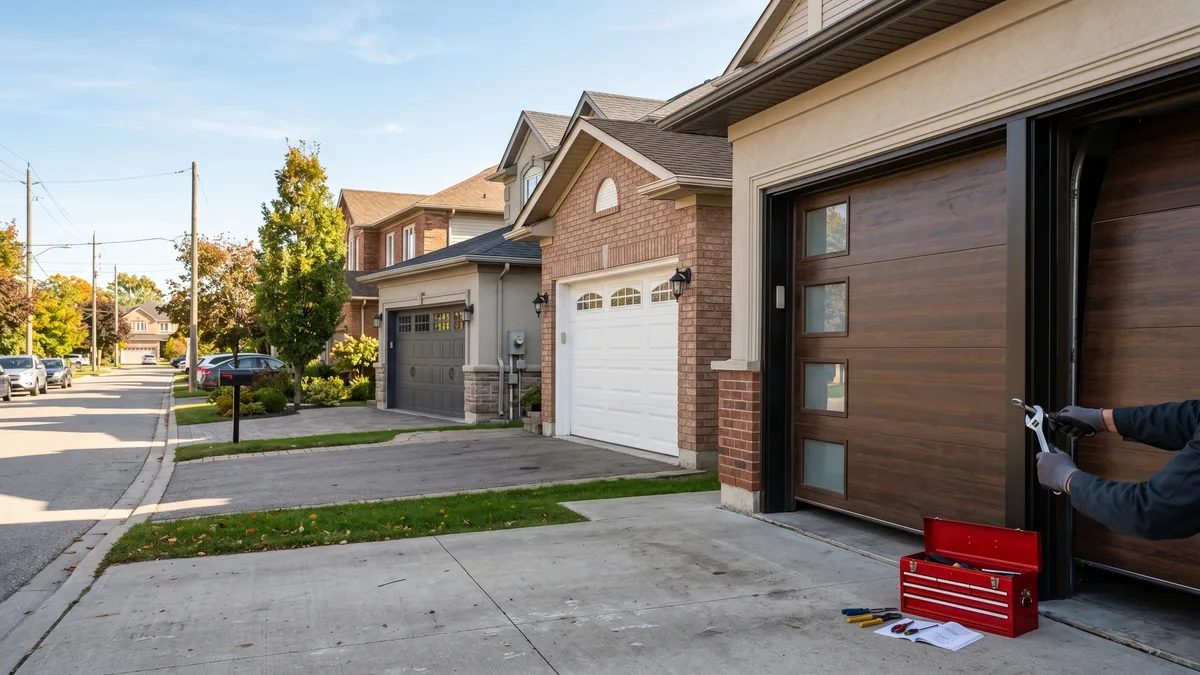
This guide covers four main garage door types, grouped by how they open: sectional (rigid horizontal panels that travel overhead — the most common in Canada), side-hinged (swing-out doors), tilt-up (one solid panel that pivots up), and slide-to-side. Each type comes in different materials — insulated steel, aluminum-and-glass, wood, and composite. For the GTA climate, an insulated steel sectional door is the best all-around choice.
What Is a Garage Door Type?
A garage door "type" describes the mechanism by which the door opens and stores — overhead, swinging, tilting, or sliding. This is separate from the door's "style" (the visual look, such as traditional raised-panel, carriage house, or modern flush) and its "material" (steel, aluminum, wood, composite, or glass). Choosing the right type first ensures the door fits your headroom, climate, and how you actually use the space.
Buying a new garage door is one of the highest-return upgrades a GTA homeowner can make — it shapes your curb appeal, your home's energy efficiency, and your daily convenience. But before you pick a colour or window pattern, you need to understand the underlying door types. Here is the field-tested breakdown I give every customer across Toronto, Mississauga, and the wider GTA.
Four Garage Door Types by Opening Mechanism
Here is how the four residential door types covered in this guide work and where each fits best.
1. Sectional Overhead Doors (the GTA standard)
A sectional door is built from three to five rigid horizontal panels (called sections) joined by hinges. As the door opens, the panels bend at each hinge and travel up vertical tracks, then curve back along horizontal tracks to rest flat against the garage ceiling. Rollers in the track and a torsion or extension spring system carry the weight.
This is the door you see on the overwhelming majority of Canadian homes, and for good reason: it seals tightly against weather, accepts thick insulation, offers strong security, and works seamlessly with an automatic opener. If a single panel gets dented by a hockey net or backing accident, you can often do a single garage door panel replacement instead of swapping the whole door.
2. Side-Hinged (Swing-Out) Doors
Side-hinged doors swing open outward from a central jamb, like a pair of large barn or carriage doors. They are a traditional look that suits heritage homes and detached garages where you walk in and out more than you drive in. They require swing clearance in front of the opening and are harder (though not impossible) to automate. Snow buildup in front of the door can block them in winter — an important GTA consideration.
3. Tilt-Up (Canopy & Retractable) Doors
A tilt-up door is a single solid slab that pivots on a pivoting hinge mechanism: the bottom swings out and up while the top tilts back into the garage. Canopy versions leave part of the door projecting outside as an awning; retractable versions pull fully inside on tracks. These were common on mid-century homes but are now rare in new builds because the swinging slab is a pinch hazard, seals poorly, and can't be easily insulated.
4. Slide-to-Side Doors
Slide-to-side doors operate by bending to one side of the garage and sitting parallel to the wall, running on a bottom track with rollers. They were among the earliest overhead-alternative designs and work well in garages with limited headroom but generous side-wall space. They are uncommon in modern residential installs but occasionally requested for specialty or accessibility builds.
| Door Type | How It Opens | Headroom Needed | Best For |
|---|---|---|---|
| Sectional Overhead | Panels travel to ceiling | Standard (12–18 in) | Most GTA homes |
| Side-Hinged | Swings outward | None (needs front clearance) | Heritage / walk-in garages |
| Tilt-Up Canopy | One slab pivots up | Moderate | Older homes (legacy) |
| Slide-to-Side | Bends to one wall | Very low | Specialty / accessibility |
Garage Door Materials Compared
Once you've settled on a type (usually sectional for GTA homes), the material drives the look, the maintenance, and how well the door handles our winters.
Steel
Steel is the most popular material in Canada. It comes in single-layer (steel only), double-layer (steel + insulation), and triple-layer (steel + polyurethane foam + steel) constructions. A two- or three-layer insulated steel door resists dents, blocks cold, dampens road noise, and needs almost no upkeep. For most homeowners considering a garage door replacement, insulated steel is the value sweet spot.
Aluminum & Glass (Full-View)
Aluminum frames with glass or acrylic panels create the sleek, modern "full-view" look popular on contemporary GTA builds. They are light and rust-proof, but for our climate you should specify insulated (double-pane) glass to limit heat loss and condensation. Aluminum frames can dent more easily than steel.
Wood & Wood Composite
Real wood (cedar, hemlock, mahogany) delivers unmatched warmth and authentic carriage-house character, but it demands regular refinishing to survive freeze-thaw cycles and moisture. Wood-composite doors mimic the look of stained wood with a steel or fibreboard core, giving you the appearance with far less maintenance.
Fibreglass & Vinyl
Fibreglass doors resist dents and salt-air corrosion and can be moulded to look like wood, but they can become brittle and crack in extreme cold — a real factor in GTA winters. Vinyl doors are nearly indestructible and kid-proof, popular for busy households, though colour and style choices are more limited.
When customers ask me which material lasts longest in our climate, my honest answer is that construction quality matters as much as the base material. A well-built insulated steel sectional with quality rollers, hinges, and a torsion spring system rated for your door weight will routinely give 15–20 years of reliable service with basic maintenance. A cheap door of any material, installed with undersized springs or the wrong track, will frustrate you within a few seasons. That is why I always recommend matching the door's hardware and spring system to its actual weight rather than chasing the lowest sticker price.
Garage Door Styles: The Look on Top of the Type
Style is the visual design layered onto your door type. The three dominant residential styles are:
- Traditional / Raised-Panel: The classic rectangular panel grid. Timeless, affordable, and suits the majority of GTA brick and siding homes.
- Carriage House: Designed to echo old swing-out barn doors with decorative hardware, cross-bracing, and often arched windows — but built as a modern sectional door that opens overhead. Hugely popular for adding character.
- Modern / Contemporary: Clean flush panels or aluminum-and-glass full-view doors with minimal detailing, matching new-build and renovated modern facades.
You can preview combinations of style, colour, and window inserts on your own home photo using our online door designer before you commit.
How to Choose the Right Garage Door Type
Use this short decision framework to narrow your options quickly:
- Measure your headroom. Standard sectional tracks need roughly 12–18 inches above the opening. If you have less, ask about a compatible low-headroom track kit, side-hinged option, or wall-mount jackshaft opener that frees ceiling space.
- Decide attached vs detached. An attached garage that shares a wall with living space should always be insulated. A detached, unheated garage can use a lighter, less-insulated door.
- Match the architecture. Carriage style for traditional and heritage homes; full-view glass or flush modern for contemporary builds.
- Set your maintenance tolerance. Want zero upkeep? Choose insulated steel or vinyl. Want premium looks and willing to refinish? Choose wood.
- Confirm opener compatibility. Most types pair with a standard opener, but heavy or insulated doors and tight-headroom setups may need a stronger or wall-mount unit — see our opener repair and installation page.
It is also worth thinking about safety standards no matter which type you choose. Every automatic opener sold in North America must meet the International Door Association-supported UL 325 reversing standard, which requires photo-eye sensors and an auto-reverse function. If you are replacing an older door and opener together, you'll gain these modern safety features automatically — an important consideration in households with children or pets.
What New Garage Doors Cost in the GTA
Pricing depends on the type, material, insulation, size, and window inserts. Here is our current supply-and-install pricing across Toronto and the GTA:
| Option | Price (CAD, + tax) | What's Included |
|---|---|---|
| Single door (8×7), supply + install | from $1,350 | Panels, hardware, weatherstripping, install, old-door removal |
| Single door (9×7) | $1,500 | Same as above, larger size |
| Double door (16×7), supply + install | from $2,300 | Full double-car door installed |
| Door only — delivery | from $850 | Door panels delivered (+$150 per size step) |
| Window inserts | +$125 / window | Optional decorative glass |
| New opener (sold separately) | from $600 | Opener, install, programming |
See full details on our pricing page. Warranties include 1-year labour, 5-year hardware, and a lifetime panel warranty against rust-through perforation.
Ready to Choose Your New Garage Door?
Our IDEA Certified team helps you pick the right type, material, and style for your home and budget — with a FREE in-home measure across Toronto & the GTA. Supply and install from $1,350.
Call 437-265-9995