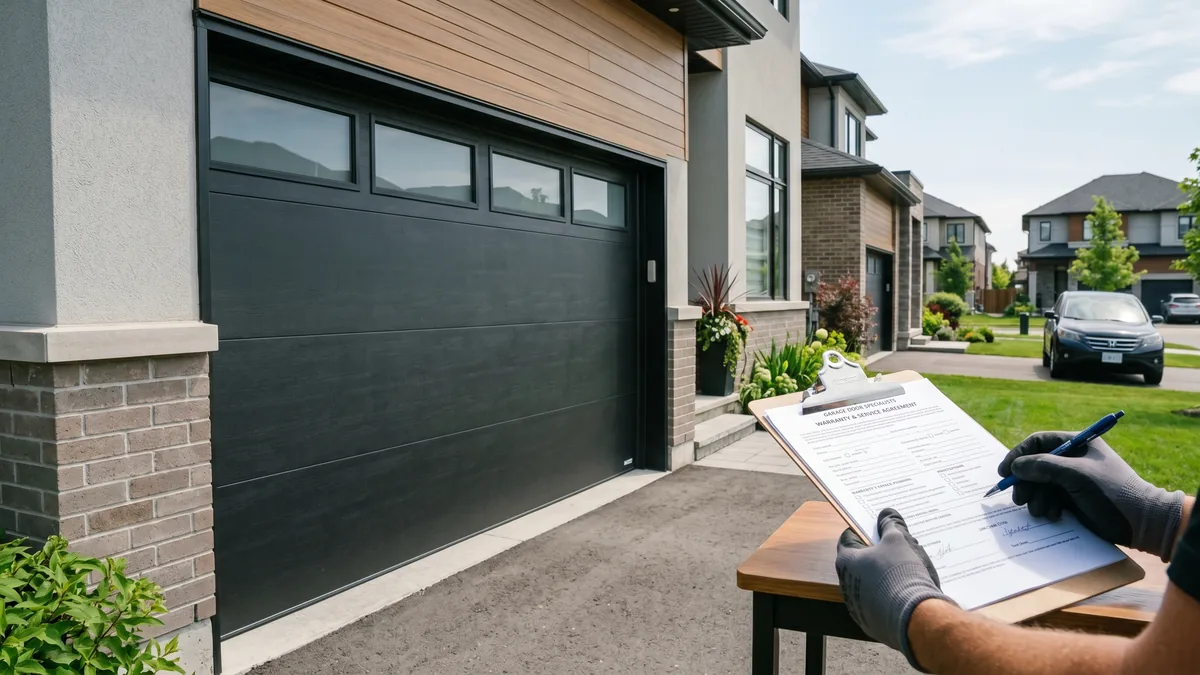
A garage door warranty has two separate parts: a manufacturer warranty on the parts (often a lifetime panel warranty against rust-through, plus 1–10 years on springs, rollers, and hardware) and an installer labour warranty covering the workmanship (usually 1–2 years). Openers carry their own warranty from the opener maker. Warranties cover manufacturing defects only — not normal wear, weather damage, accidents, or skipped maintenance. Royal Garage Doors installs carry 1-year labour, 5-year hardware, and a lifetime panel warranty.
What Is a Garage Door Warranty?
A garage door warranty is a written promise that specific parts or workmanship will be free of defects for a stated period. It is not insurance and it is not a maintenance plan. Each component — panels, springs, rollers, opener, and the installation itself — can carry a different term and a different company standing behind it. Understanding which warranty covers which part, and for how long, is the difference between a free fix and an unexpected repair bill.
Across Toronto and the GTA, “lifetime warranty” is one of the most over-promised phrases in the garage door business — and one of the most misunderstood by homeowners. After 15 years installing and servicing doors, I have seen plenty of people assume their door was fully covered, only to learn the fine print covered far less than they thought. This guide breaks down exactly what a garage door warranty covers in 2026, what quietly voids it, and how to compare coverage honestly when you buy.
The 4 Layers of a Garage Door Warranty
A complete garage door is not one product — it is a system of parts from different makers, plus the labour to assemble them. That means your “warranty” is really four overlapping warranties, each with its own length and its own company standing behind it.
1. Door Panel (Section) Warranty
This is the headline warranty most sellers advertise. On quality steel doors it is often a lifetime warranty against rust-through perforation — meaning the steel will not rot through from the inside. It usually does not cover surface rust, dents, fading, or delamination of an insulated core, which carry shorter terms. Wood and aluminum doors have different, typically shorter, panel warranties. Royal Garage Doors backs our installed door panels with a lifetime warranty against rust-through perforation. If you ever need a single damaged section swapped, see our garage door panel replacement service.
2. Hardware Warranty (Rollers, Hinges, Tracks, Brackets)
Tracks, hinges, rollers, drums, and brackets are covered separately, usually for 1 to 5 years depending on grade. Sealed nylon rollers and galvanized hardware tend to carry longer terms than builder-grade steel. Our installs include a 5-year hardware warranty. If a roller wears out down the road, our garage door roller replacement service handles it.
3. Spring Warranty
Springs are the shortest-lived high-stress part, so their warranty is measured in cycles, not years. A standard torsion spring is rated around 10,000 cycles — roughly 7 years of average use — and a basic defect warranty may be just 1 year. High-cycle springs (25,000–100,000 cycles) carry longer coverage and are common on commercial doors. Because normal fatigue failure is not a defect, a snapped spring at end-of-life is generally not a warranty claim. Learn the warning signs in our guide to a broken garage door spring.
4. Opener Warranty
Your opener is a separate appliance with its own warranty from LiftMaster, Chamberlain, Genie, or another maker — not from your installer. Premium models advertise lifetime motor or belt coverage, with shorter terms on parts and accessories. We cover brand-specific repairs through pages like LiftMaster repair, Chamberlain repair, and Genie repair.
Manufacturer Warranty vs. Labour Warranty
The single most important distinction to understand is who stands behind what. A manufacturer warranty covers the parts against defects and is honoured by the company that built them. A labour (installation) warranty covers the installer’s workmanship — if a part was fitted wrong, the installer fixes it free. They overlap but are not the same, and a great manufacturer warranty means little if the installation is sloppy and unwarranted.
| Feature | Manufacturer Warranty | Labour / Installer Warranty |
|---|---|---|
| What it covers | Defects in panels, hardware, springs, opener | Quality of the installation work |
| Who honours it | The part maker (e.g. door brand, opener brand) | The company that installed your door |
| Typical length | 1 yr to lifetime (varies by part) | 1–2 years |
| Common exclusions | Wear, weather, accidents, DIY repairs | Damage you cause after install |
| Transferable? | Sometimes, often once | Usually original owner only |
When you compare quotes, ask both questions: How long is the manufacturer warranty on each part? and How long is your labour warranty? A low price with no labour warranty often costs more within two years. You can see how we structure ours on our garage door company page and read verified customer reviews before you decide.
Royal Garage Doors Warranty at a Glance
For a new supply-and-install in the GTA, here is exactly what our coverage includes — written plainly so there are no surprises.
| Component | Royal Warranty |
|---|---|
| Door panels (sections) | Lifetime — rust-through perforation |
| Hardware (rollers, hinges, tracks) | 5 years |
| Installation labour / workmanship | 1 year |
| Opener | Per opener manufacturer (1 yr–lifetime) |
| Springs | 1 year against defects (cycle-rated) |
A new supply-and-install starts at $1,350 + tax for an 8×7 single door, and the door panels, hardware, weatherstripping, old-door removal, and a safety check are all included. See the full breakdown on our garage door replacement and installation cost pages.
What Voids a Garage Door Warranty
Manufacturers write generous-sounding warranties precisely because so many claims are excluded. These are the most common ways homeowners unknowingly void coverage — avoid them and keep your paperwork.
- Unqualified or DIY installation. Most panel and opener warranties require professional installation. A door installed by a handyman or by you often has no manufacturer coverage at all.
- Skipped maintenance. Manufacturers expect regular lubrication and inspection. A spring or roller that failed from neglect is not a defect. A simple annual tune-up protects the warranty.
- Non-approved parts. Mixing in an off-brand spring, drive gear, or opener accessory can void the related warranty.
- Physical damage. Backing a car into the door, storm impact, or flooding are accidents, not defects — that is what home insurance is for.
- Wrong paint or finish. Painting a steel door with the wrong product, or a dark colour the maker prohibits on certain panels, can void the panel warranty. See our guide on how to paint a steel garage door correctly.
- Opening the opener head. Many opener warranties are void the moment the motor housing is opened for DIY repair.
How to Read a Warranty Before You Buy
A warranty is only as good as its fine print. Before you sign an install contract anywhere in the GTA, work through this checklist.
- Get the term for each part separately. “Lifetime warranty” usually means only the panel against rust-through — ask for springs, rollers, opener, and labour individually.
- Confirm what “lifetime” means. Lifetime of the original owner? Of the product? Pro-rated after a few years? These differ enormously in real value.
- Check transferability. If you may sell, a transferable panel warranty adds resale value. See our notes on how long a garage door lasts.
- Read the maintenance requirements. If annual professional service is required to keep coverage, factor that in.
- Verify it is in writing. A verbal “lifetime warranty” is worth nothing. Get the manufacturer warranty document and the installer’s labour terms on the invoice.
- Match coverage to climate. In our freeze-thaw GTA winters, rust-through and weatherstripping warranties matter most. Insulated steel doors are a smart match for cold-climate durability.
How to File a Garage Door Warranty Claim
If a covered part fails, the process is straightforward when your records are in order. Here is how it typically works in Ontario.
- Identify which warranty applies. Panel, hardware, spring, or opener — each may go to a different company.
- Gather your proof. Original invoice, warranty document, serial or model numbers, and maintenance records.
- Contact the right party. For workmanship, call your installer; for a part defect, the manufacturer (or have your installer file on your behalf).
- Book an inspection. A technician confirms the failure is a defect, not wear or damage. Royal Garage Doors offers a FREE service call with any repair — a $120 diagnostic applies only if you choose not to proceed.
- Approve the fix. Covered defects are repaired or the part replaced at no parts cost; you may still pay labour if the labour warranty has expired.
For authoritative warranty standards and how garage door products are tested and rated, the trade body DASMA (Door & Access Systems Manufacturers Association) publishes the technical data sheets many manufacturers reference. You can also book service directly through our online booking page.
What Repairs Cost If You Are Out of Warranty
Even the best door eventually needs out-of-warranty work, especially on wear parts. Knowing GTA pricing helps you judge whether a warranty’s real value matches its marketing.
| Service | Typical Cost (CAD) |
|---|---|
| Maintenance & tune-up | $120 + tax |
| Safety sensors | $120–$180 + tax |
| Cables & brackets | $180–$260 + tax |
| Weather seal | $120–$260 + tax |
| Single torsion spring | from $280 + tax |
| Double spring set | $320–$460 + tax |
| New opener / motor | from $600 + tax |
| Panel replacement | $500–$1,000 + tax |
| Supply + install (8×7 single) | from $1,350 + tax |
For full, current pricing on every service, see our garage door pricing page. Need a hand from a local team? We serve Toronto, Mississauga, Brampton, Hamilton, and the wider GTA. For new doors and styles, browse our overhead garage doors and opener service.
Buying a New Door? Get the Warranty in Writing.
Royal Garage Doors backs every install with a lifetime panel warranty, 5-year hardware, and 1-year labour — spelled out clearly on your invoice. FREE service calls with any repair across Toronto & the GTA, same-day available.
Call 437-265-9995