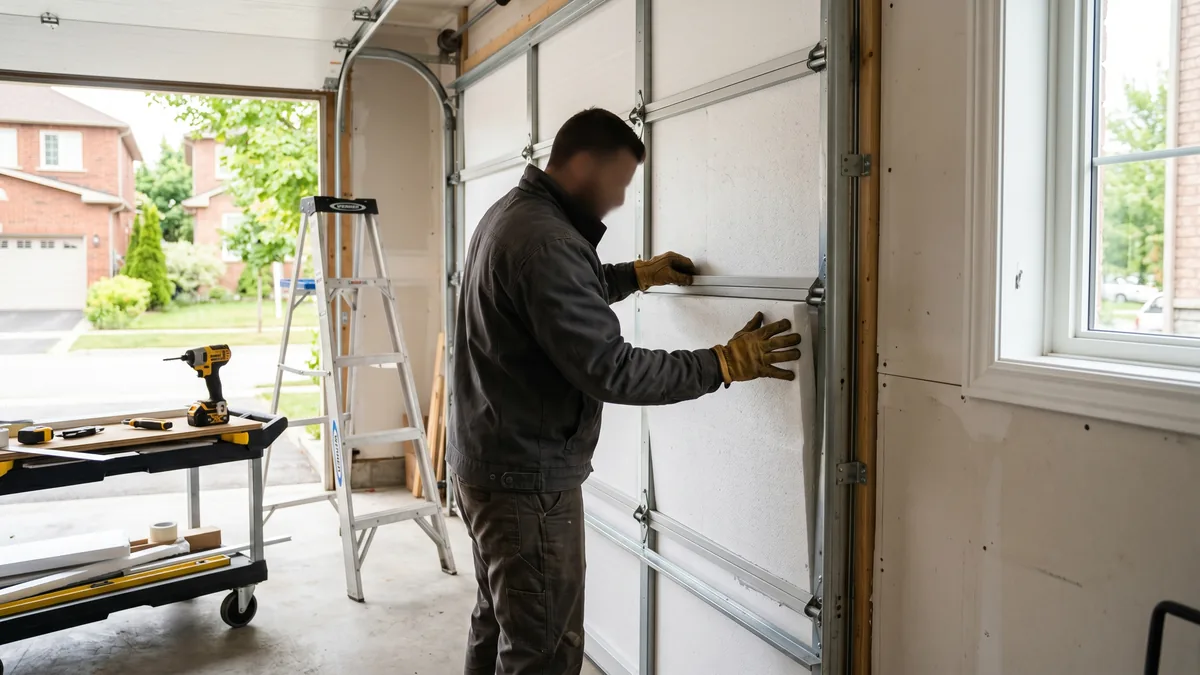
In 2026 across the GTA, a DIY garage door insulation kit costs about $60–$200, while professional batt or foam-board insulation plus new weather seal runs roughly $200–$600 depending on door size. A new factory-insulated door starts from $1,350 + tax installed (8×7) and reaches a far higher R-value than any retrofit. Kits add only about R-4–R-8; a true insulated door reaches R-12–R-18 with a sealed, warranted section. Adding any insulation adds weight, so the door balance should be rechecked afterward.
What Does "Insulating a Garage Door" Actually Mean?
Insulating a garage door means adding a layer of thermal material — rigid foam board, reflective foil, or batt insulation — to the inside of the door panels, then sealing the gaps around the edges with weatherstripping. The goal is to raise the door’s R-value (resistance to heat flow) so less heat escapes in winter and less heat enters in summer. A non-insulated single-layer steel door is essentially R-0 to R-2; insulation and good seals turn that drafty panel into a real thermal barrier.
If your garage is freezing in January, sweltering in July, or sits under a bedroom that never warms up, the garage door is usually the weakest link — it is the largest uninsulated surface in most Toronto and GTA homes. The good news is there are three clear paths, at three very different price points. This guide breaks down what each really costs in 2026, the R-values you actually get, and when a new insulated door is the smarter buy instead of a retrofit.
Cost to Insulate a Garage Door: The 3 Options at a Glance
There is no single price to "insulate a garage door" because there are three very different jobs hiding under that phrase. A DIY kit upgrades the door you already own. A professional retrofit does the same with better materials and a balance check. And a new insulated door replaces the panel entirely with a factory-sealed, multi-layer section. Here is how they compare on price and performance.
| Option | Typical Cost (CAD) | R-Value Added | Best For |
|---|---|---|---|
| DIY foam/batt kit (single door) | $60–$120 | R-4 to R-6 | Budget upgrade, detached garage |
| DIY kit (double door) | $120–$200 | R-4 to R-8 | Handy DIYers, storage garages |
| Professional retrofit + weather seal | $200–$600 | R-6 to R-8 | Done-right job, balance recheck |
| New insulated door (8×7 single) | from $1,350 + tax | R-12 to R-18 | Old/dented door, heated garage |
| New insulated door (16×7 double) | from $2,300 + tax | R-12 to R-18 | Attached garage, room above |
The cheapest path is rarely the best long-term value. A retrofit kit makes a thin single-layer door warmer, but it cannot match the R-12 to R-18 of a polyurethane-injected steel sandwich door, and it does nothing for a door that is already dented, rusting, or out of balance. If your door is more than 15 years old, weigh the kit against a garage door replacement before spending money on the old panel.
DIY Garage Door Insulation Kit Costs
For most homeowners, a kit is the first thing they price out — and for a detached, unheated storage garage it can be the right call. Kits sold at GTA home centres come in three main styles, each with its own cost and R-value.
Foam Board Kits ($60–$120)
These use rigid polystyrene panels (often faced with white vinyl or foil) that snap into retention clips on the back of each door section. They are the most popular DIY choice, deliver roughly R-4 to R-6, and look clean from inside the garage. A single-door kit covers a typical 8×7 or 9×7 door; a double door needs two kits.
Reflective Foil Kits ($50–$90)
Double-bubble or foil-faced kits are the cheapest option and the easiest to install with adhesive or tape. They reflect radiant heat well, which helps in summer, but their true R-value is modest — usually R-3 to R-5. In a cold GTA winter, foil alone is the weakest performer of the three.
Batt / Fiberglass Kits ($70–$130)
Vinyl-faced fiberglass batts deliver the highest DIY R-value, around R-6 to R-8, and are good at deadening noise. They are bulkier and a little messier to cut, and they add the most weight — which matters for your spring balance (more on that below).
How to Insulate a Garage Door Yourself (Step by Step)
If your door is a flat steel sectional in good shape and lifts smoothly by hand, a kit is a realistic weekend project. Here is the method I walk customers through when they want to do it themselves.
- Measure each panel. Measure the height and width of each door section between the horizontal stiles so you can cut insulation to fit snugly inside each recessed panel.
- Cut the insulation. Cut foam board or batt panels about an inch larger than the opening so they bow slightly and stay seated, or so they fit the supplied retaining clips.
- Install retaining clips. Press the retention pins or clips onto the centre of each door section where the insulation will rest.
- Fit the insulation. Tuck each cut panel behind the door rails and push it onto the clips so the vinyl or foil face points into the garage.
- Add bottom and side weather seal. Replace the bottom seal and add side and top weatherstripping so the insulated door also stops air leaks around the edges.
- Recheck door balance. After adding weight, test the balance by hand and have a technician adjust spring tension if the door no longer holds halfway.
Professional Insulation Costs in the GTA
Paying a technician to insulate your door costs more than a kit but buys you three things a DIY job often skips: correctly sized materials, fresh weatherstripping all the way around, and a spring-balance recheck so the extra weight does not wear out your opener. Expect roughly $200–$600 + tax depending on door size, the material chosen, and how much weather sealing is involved.
Where a pro job really earns its keep is the diagnosis. If your garage is cold despite an "insulated" door, the real culprit is often a perished bottom seal, missing side seals, or a single dented panel — cheaper to fix than to re-insulate. We can replace a damaged panel ($500–$1,000), renew the rollers, or fit fresh weather seal in the same visit. Compare options on our pricing page or book an assessment — the service call is FREE with any repair.
| Related Service | Typical Cost (CAD) |
|---|---|
| Weather seal (bottom / side / top) | $120–$260 + tax |
| Maintenance & tune-up (incl. balance check) | $120 + tax |
| Single torsion spring (after added weight) | from $280 + tax |
| Cables & brackets | $180–$260 + tax |
| Panel replacement | $500–$1,000 + tax |
| New insulated door (supply + install, 8×7) | from $1,350 + tax |
R-Values Explained: What Do You Actually Need?
R-value measures resistance to heat flow — higher is better. The number printed on a garage door is usually the centre-of-section R-value, which is higher than the whole-door "effective" R-value once you account for the rails and seams. Still, it is the best apples-to-apples figure for comparing doors and kits. Here is what makes sense for our climate.
| Garage Type | Recommended R-Value | Best Path |
|---|---|---|
| Detached, unheated (storage) | R-6 to R-9 | DIY kit or pro retrofit |
| Attached, unheated | R-9 to R-12 | Retrofit or new door |
| Attached, heated workshop | R-12 to R-16 | New insulated door |
| Room above the garage | R-16 to R-18 | New insulated door |
Factory doors hit these numbers because they sandwich a thick polyurethane or polystyrene core between two steel skins. A DIY kit on a single-layer door simply cannot reach R-12, no matter what the box claims about the foam alone — the thin steel skin and the seams around each panel cap the real-world result at roughly R-4 to R-8. For specifics on door construction and certified R-values, the manufacturer-neutral standards body DASMA publishes the testing method most brands cite, and Canada’s Natural Resources Canada covers home energy efficiency for cold climates.
Insulated Door Construction: Single vs Double vs Triple Layer
When shopping for a new insulated door, the layer count tells you most of the story. Single-layer (pan) doors are just one steel skin — essentially uninsulated. Double-layer doors add a foam or polystyrene backer (around R-6 to R-9). Triple-layer "sandwich" doors enclose a thick polyurethane core between two steel skins and reach R-12 to R-18, the construction we recommend for any heated or attached GTA garage. We install and sell multiple brands at these tiers; see our best garage doors for cold climates guide and the broader insulated door energy savings breakdown.
Is Insulating a Garage Door Worth It?
It depends entirely on how you use the garage. Insulation is genuinely worth it — and pays back fastest — in these situations:
- You have a heated garage or workshop. Every degree you keep in is money saved; a sealed, insulated door is the single biggest improvement.
- There is living space above or beside the garage. An uninsulated door lets cold pour in under the bedroom floor; insulating it steadies the whole zone.
- The garage is attached and shares a wall with the house. A warmer garage means a warmer adjoining wall and less draft into the mudroom.
- You want a quieter, sturdier door. Insulated doors are noticeably quieter and more rigid, which also reduces rattling — see our soundproofing guide.
For a detached, unheated garage you only use for parking and storage, the heating-bill savings are minimal — the real payoff is comfort, less ice on the car, and protecting paint, tools, and stored items from deep cold. In that case a $60–$200 DIY kit is plenty; spending on a new door is harder to justify on energy grounds alone.
Retrofit Kit vs New Insulated Door: Which to Choose
This is the decision that matters most for your wallet. Use this rule of thumb: insulate what you have if the door is structurally sound and the garage is unheated; replace it if the door is old, damaged, or the garage is heated or has a room above.
Our Honest Recommendation
If your existing door is a solid single-layer steel sectional and you mainly want to take the edge off a cold, unheated garage, a $60–$200 DIY kit plus fresh weatherstripping is excellent value — just recheck the balance afterward. But if the door is 15+ years old, dented, noisy, or your garage is heated or sits under a bedroom, skip the retrofit. A new triple-layer insulated door from $1,350 + tax delivers R-12 to R-18, a sealed section, quieter operation, and a warranty (1-year labour, 5-year hardware, lifetime panel) that no kit can match.
We sell and install insulated doors from several reputable manufacturers at different price and R-value tiers, so the choice is about your garage and budget, not a single brand. Browse our overhead garage doors range, read brand comparisons like Clopay vs Wayne Dalton and Wayne Dalton vs Amarr, or talk to the team at Royal Garage Doors about what fits your home.
Garage Door Insulation Across Toronto & the GTA
Our freeze-thaw winters are exactly why insulation matters here more than in milder regions. A door that is comfortable in October can be a cold-air waterfall by January, and the temperature swing also dries out seals and strains springs. We help homeowners insulate, re-seal, and replace doors across Toronto, Mississauga, Brampton, and Hamilton. Whether you want a quick weather-seal-and-kit refresh or a full insulated-door upgrade, we will give you the honest math first.
Curious what neighbours decided? Read real customer reviews, and if you are weighing a single vs double door for a bigger garage, our double vs two single doors guide compares insulation and cost trade-offs.
Cold Garage? Get a Straight Answer on Insulation
We will tell you whether a $100 weather-seal-and-kit refresh fixes it, or whether a new insulated door is the smarter buy — with FREE service calls on any repair across Toronto & the GTA and same-day appointments available.
Call 437-265-9995