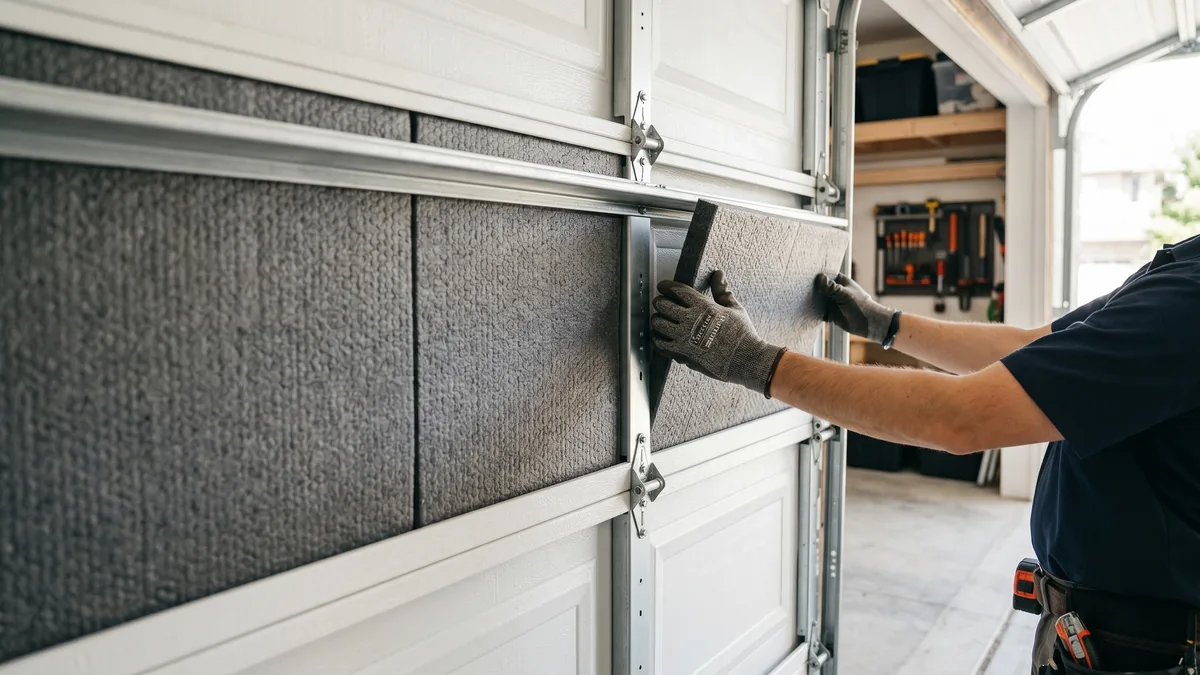
To soundproof a garage door, work in layers: quiet the mechanism, then block the sound. First lubricate and tighten everything, swap builder-grade steel rollers for sealed nylon rollers, and replace a chain-drive opener with a belt drive. Then seal the bottom, sides and top, add an insulation kit, and for rooms above the garage add mass-loaded vinyl. This combination usually cuts garage door noise by half or more. Any time you add weight, have a technician re-balance the door so the springs and opener are not overloaded.
What Does Soundproofing a Garage Door Actually Mean?
Soundproofing a garage door means tackling two different problems at once: the noise the door itself makes as it moves (rattle, grinding, chain slap) and the sound that passes through the thin door panels and air gaps (traffic, wind, voices). The first is solved mechanically with quiet rollers, lubrication and a belt-drive opener; the second is solved acoustically by adding mass, insulation and tight seals. A truly quiet garage needs both.
If your garage door wakes the house at 6 a.m. or you are finishing the room above it into an office or bedroom, you do not have to live with the rumble. Across Toronto and the GTA I help homeowners turn a banging, grinding door into something the neighbours barely hear — usually without replacing the whole door. Here is exactly how to soundproof a garage door in 2026, what each step costs, and where a quick professional tune-up beats hours of DIY.
Why Garage Doors Are So Loud
Before you spend a dollar, it helps to know where the noise comes from. Garage door noise falls into two categories, and the fixes are completely different for each.
- Structure-borne noise (the mechanism). This is the metallic chatter, grinding and chain slap you hear when the door moves. It travels through the tracks, the springs, and especially the opener bolted to the ceiling joists — which is why a chain drive sounds so loud in the room above an attached garage.
- Airborne noise (sound passing through). A single-layer steel door is essentially a thin drum with gaps around the edges. Traffic, wind, barking dogs and conversation pass straight through the panels and the air leaks at the bottom and sides.
Most homeowners who say their door is “too loud” are hearing structure-borne noise, which is the cheapest to fix. If you are trying to block outside sound from a finished garage, you are fighting airborne noise, which takes mass and sealing. The five-step plan below handles both.
How to Soundproof a Garage Door: 5 Steps
Work through these in order. Each step is useful on its own, but together they compound — and the early steps are the cheapest with the biggest payoff.
Step 1 – Lubricate and Tighten the Mechanism
A garage door cycles thousands of times a year, and vibration loosens hinge screws, roller brackets and track bolts. Loose hardware lets panels rattle; dry rollers and hinges grind. Tighten every nut and bolt with a socket wrench (do not overtighten), then apply a silicone or garage-door-specific lubricant to rollers, hinges, springs and bearing plates. Avoid WD-40 — it is a degreaser, not a lubricant. This single step quiets the majority of “loud” doors and costs nothing but 15 minutes. If you would rather have it done right, a professional garage door tune-up covers this plus a balance check.
Step 2 – Install Quiet Nylon Rollers
Builder-grade steel rollers have exposed bearings that rust, dry out and grind metal-on-metal inside the tracks. Sealed nylon rollers roll quietly and last far longer. Swapping all the rollers is the single most effective noise upgrade on most doors. The intermediate rollers are an accessible DIY job, but the bottom roller sits in a bracket attached to the lift cable under tension — see our cable-off guide and the roller replacement service rather than forcing it. Need a hand? Our team handles full roller sets across the GTA.
Step 3 – Seal the Perimeter and Bottom
Air gaps are sound gaps. A worn bottom seal, missing side seals or a gapped top seal let in wind, weather and noise alike. Replacing the bottom astragal and adding side and top weatherstripping tightens the door acoustically and thermally at the same time — a double win in our GTA winters. For details on the options, see our guides to the side and top seal and the difference between a threshold and a bottom seal. Professional panel and seal work is available if your door is older.
Step 4 – Add Insulation and Mass
A single-layer steel door resonates like a drum. A garage-door insulation kit (rigid polystyrene or polyurethane panels cut to each section) adds mass and damping that kills resonance and reduces sound passing through. For rooms above or beside the garage, you can add a layer of mass-loaded vinyl (MLV) to the inside face for true airborne blocking. Insulation also raises the door’s R-value — read our cost to insulate a garage door and insulated door energy savings guides. If your door is thin, old or rusting, replacing it with a factory-insulated door is often quieter and more airtight than retrofitting.
Step 5 – Isolate and Upgrade the Opener
If you have an old chain-drive opener, this is your biggest single noise win for an attached garage. Chain drives slap and vibrate, and that vibration travels straight through the ceiling into the room above. A belt-drive opener runs dramatically quieter. Pair it with rubber isolation pads between the motor hanger bracket and the joists so structure-borne vibration is decoupled. We service and install all major brands — LiftMaster, Chamberlain, Genie and Wayne Dalton. For diagnosis and replacement, see our opener repair page.
Soundproofing Methods Compared
Not every method does the same job. Use this table to match the fix to your actual problem — a mechanism that is too loud needs different work than a garage that lets outside noise in.
| Method | Best For | Noise Type | DIY? |
|---|---|---|---|
| Lubricate & tighten | Rattle & grinding | Structure-borne | Yes |
| Nylon rollers | Metal grinding in tracks | Structure-borne | Partial |
| Belt-drive opener | Chain slap, room above garage | Structure-borne | Pro recommended |
| Perimeter & bottom seals | Wind & outside noise leaks | Airborne | Yes |
| Insulation kit | Drum-like resonance | Both | Yes |
| Mass-loaded vinyl | Finished room next/above garage | Airborne | Yes (re-balance after) |
| New insulated door | Old, thin or damaged door | Both | No |
What It Costs to Soundproof a Garage Door in the GTA
The good news is that the most effective quieting steps are also the cheapest. Here is what each part of the job typically costs across Toronto and the GTA. All prices are in CAD plus tax, and a service call is FREE with any repair or installation — a $120 diagnostic fee applies only if you choose not to proceed.
| Service | Typical Cost (CAD) |
|---|---|
| Maintenance & tune-up (lube, tighten, balance) | $120 + tax |
| Weather sealing (bottom / side / top, by size) | $120–$260 + tax |
| Cables & brackets (if worn) | $180–$260 + tax |
| Quiet belt-drive opener (supplied & installed) | from $630 + tax |
| Single torsion spring (re-balance after added weight) | from $280 + tax |
| Panel replacement (if damaged) | $500–$1,000 + tax |
| New insulated door, supply + install (8×7) | from $1,350 + tax |
DIY insulation kits and mass-loaded vinyl add material cost on top of the figures above. A new insulated double door (16×7) supply and install starts from $2,300 + tax, and window inserts add $125 per window. For full, current numbers see our pricing page, the installation cost guide, and the opener installation cost guide. New doors and openers carry a 1-year labour, 5-year hardware and lifetime panel warranty.
DIY vs. Hiring a Pro
Lubricating, tightening, sealing and adding an insulation kit are genuinely DIY-friendly. Where I always recommend a professional is anything touching the springs, cables or bottom brackets, and the door re-balance after you add weight. Getting the balance wrong burns out openers and shortens spring life — the springs cost less than the opener you would replace. If you want it handled end to end, our garage door company and local crews in Toronto, Mississauga, Brampton and Hamilton offer same-day service.
Soundproofing a Finished or Heated Garage
If you are converting the garage into a gym, studio, office or bedroom, the door is only one surface — but it is the weakest one acoustically. For those projects, the priority order changes: seal every air gap first (sound leaks like water through the smallest hole), then add mass with an insulation kit plus mass-loaded vinyl, and finally upgrade to a belt-drive opener so the mechanism does not undo your work. For ratings on door insulation and air-tightness standards, the Door & Access Systems Manufacturers Association (DASMA) publishes technical data sheets, and Canada’s Natural Resources Canada offers guidance on door R-values for our climate. If the existing door is old or single-layer, a modern factory-insulated overhead door will outperform any retrofit on both sound and energy.
A Note on Commercial Spaces
Workshops, studios and small commercial bays have the same physics but heavier doors and higher cycle counts. There, a sealed insulated sectional door, standard torsion springs, and scheduled maintenance do most of the acoustic work. See our commercial garage door repair page if you are quieting a business location.
Want a Quieter Garage Door — Done Right?
From nylon rollers and weather seals to a quiet belt-drive opener and a proper re-balance, Royal Garage Doors makes GTA garage doors quieter without the guesswork. FREE service call with any repair, same-day appointments available.
Call 437-265-9995