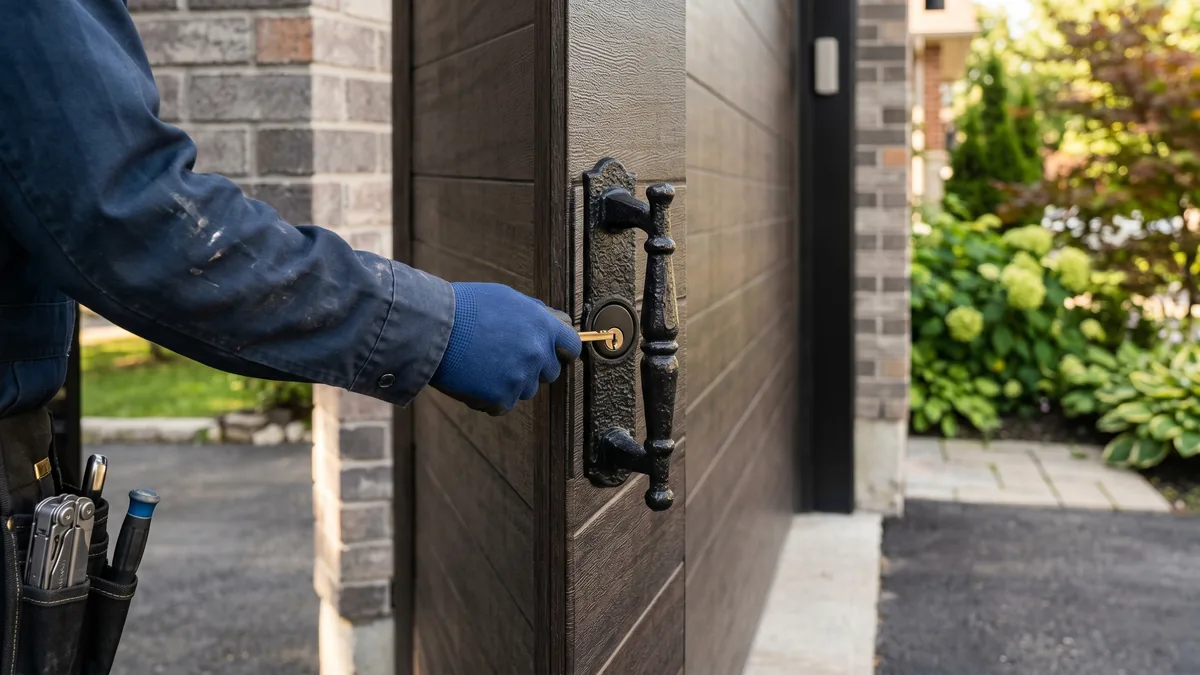
To replace a garage door handle and lock: unlock the door from inside, remove the two carriage bolts holding the old T-handle from the interior with a 1/2-inch socket, then pull the handle and lock cylinder out from the exterior. Push the new T-handle through the same two holes, reconnect the spring clip and the two horizontal lock bars on the inside, and tighten the bolts. The whole job takes 20–30 minutes and a replacement handle-and-lock kit costs about $20–$60 in parts.
What Is a Garage Door Handle?
A garage door handle is the exterior gripping point used to lift or pull a manual door, and on most sectional doors it doubles as a lock housing. The common "T-handle" holds a keyed lock cylinder that, when turned, retracts or extends two horizontal lock bars that slide into slots in the vertical tracks, mechanically bolting the door shut on both sides.
A wobbly, rusted, or seized garage door handle is more than cosmetic — it is the part you grab every time you operate a manual door and the security point that bolts the door to the track. Replacing it is one of the most beginner-friendly garage door repairs, and unlike spring or cable work, there is no stored tension involved. Here is exactly how I do it on service calls across Toronto and the GTA.
Garage Door Handle and Lock Types
Before you buy a replacement, identify what you actually have. Most residential doors in the GTA fall into one of these categories:
- T-handle lock (most common): A T-shaped exterior handle with a centre key cylinder. Turning the key pulls two spring-loaded lock bars inward, releasing them from the track. Standard on sectional steel doors from Clopay, Wayne Dalton, Amarr, and Garaga.
- Slide lock / lock bar only: A simple interior handle that you slide sideways to drive a single bar into the track. No exterior key. Common on older or detached-garage doors.
- Side-mount handle with rim lock: Found on one-piece tilt-up doors. A handle on the door face turns a latch mechanism mounted to the inside.
- Lift handle (non-locking): A plain grab handle with no lock at all, used purely to pull a light door down.
The T-handle is by far the most common, so this guide focuses on it. The good news: T-handles are largely standardized, with the two mounting bolts spaced the same distance apart on most North American doors, so a generic replacement kit usually fits. If your door has unusual hardware, our garage door company can match an exact OEM part.
What Is a Lock Cylinder?
The lock cylinder is the small cylindrical keyed barrel that sits inside the T-handle. It contains the disc tumblers that the key turns. Because the cylinder is a separate, replaceable part, you can often swap just the cylinder (and get new keys) without replacing the entire handle — though a full handle-and-lock kit is usually only a few dollars more.
Tools and Parts You Will Need
This is a low-cost, low-tool job. You almost certainly have everything in your toolbox already:
- 1/2-inch socket or wrench (and a screwdriver for some models) to remove the interior carriage bolts
- Pliers to disconnect the lock bar spring clips
- Replacement T-handle and lock kit — sold at any hardware store or online for $20–$60, usually including the handle, cylinder, two keys, lock bars, springs, and clips
- Penetrating oil (such as a light machine oil) if the old bolts are rusted — useful in our humid GTA climate
- A second person (optional) to hold the handle outside while you work inside
How to Replace a Garage Door Handle Step by Step
Allow about 20–30 minutes. Work with the door fully closed so the handle and lock bars are at a comfortable height.
- Disengage the lock. From inside, turn the interior knob or pull the lock bars so they are fully retracted out of the track slots. The door must not be bolted while you work.
- Disconnect the lock bars. Using pliers, unhook the spring and the connecting clips that link each horizontal lock bar to the centre of the handle assembly. Slide the bars out of their guide brackets and set them aside.
- Remove the carriage bolts. On the inside face of the door you will see two bolts (usually 1/2-inch heads) passing through to the exterior handle. Hold the handle outside while you loosen and remove both nuts.
- Pull the old handle out. From the exterior, withdraw the handle and its lock cylinder through the two holes. Note the orientation — the cylinder and the bar-actuating cam face a specific way.
- Fit the new handle. Insert the carriage bolts of the new T-handle through the same two holes from the outside. The square shoulders under the bolt heads seat into the door skin to stop the bolts spinning.
- Reattach the lock bars. Inside, reconnect each lock bar to the new cam, reinstall the return springs and clips, and confirm both bars slide freely in and out of the track slots when you turn the key.
- Tighten and test. Snug the interior nuts (do not overtighten and dimple the door), then test: with the key, the bars should fully extend into both tracks and fully retract clear of them. Test the key from outside too.
Replacing or Rekeying the Lock Cylinder
If the handle is fine but the lock is sticky, the key is worn, or you have lost keys after a move, you can address just the cylinder:
Replacing the cylinder
Most T-handle cylinders are held by a small spring clip or retaining pin behind the handle face. Remove the handle (steps 1–4 above), push out the old cylinder, drop in the new one, and reinstall. New cylinders ship with their own keys.
Rekey vs replace
Technically a locksmith can rekey a disc-tumbler cylinder, but for garage door handles it is almost always cheaper and faster to replace the cylinder outright, since a new handle-and-lock kit costs less than a locksmith call-out. Rekeying only makes sense if you need the garage key to match an existing house key on the same keyway.
| Option | Best For | Typical Parts Cost | DIY Difficulty |
|---|---|---|---|
| New T-handle + lock kit | Worn, rusted, or wobbly handle | $20–$60 | Easy (20–30 min) |
| Lock cylinder only | Sticky lock, lost keys, good handle | $10–$25 | Easy (15 min) |
| Slide lock / lock bar | Interior-only locking door | $10–$20 | Easy (15 min) |
| Locksmith rekey | Matching an existing house key | Service call quote | Pro only |
| Professional service | Opener-equipped or jammed doors | Bundled in repair | We handle it |
Common Handle and Lock Problems (and Fixes)
These are the issues that bring our GTA techs out for handle and lock work:
- Door won't open after unlocking: One lock bar has not fully retracted, or a bar is bent and caught in the track. Inspect both sides and straighten or replace the bar. This is also a frequent cause behind a door that gets stuck mid-travel.
- Key turns but bars don't move: The internal cam or spring clip has failed or popped off. Reconnect the clip or replace the handle.
- Frozen or seized lock in winter: GTA winters drive moisture into the cylinder. A dry graphite lubricant frees most locks; avoid wet oils that attract grit and freeze again. See our guide to stopping a garage door freezing to the ground.
- Handle pulls loose / dimples the door: Over-tightened bolts have crushed the door skin. Use a backing washer and snug, don't crank.
- Lock bar scrapes the track: Misaligned guide bracket. Loosen, realign so the bar enters the track slot cleanly, and retighten.
Security Considerations for GTA Homes
A garage door handle lock is a basic deterrent, not a high-security barrier — disc-tumbler cylinders are simple by design. For real security, the priorities are different:
- The opener is your primary lock. A powered opener holds the door far more securely than the manual bars. Keep the door in good balance so the opener seats it firmly — if yours strains, check the spring condition first.
- Secure the emergency release. The red release cord can be fished open from outside with a coat hanger on many doors. A release-cord shield closes this gap.
- Use the manual lock for long absences. Engage the T-handle lock (and unplug the opener) when away for an extended period, since the door cannot then be lifted even if the opener is defeated.
- Don't leave openers in the car. A visible remote plus a registration with your address is an invitation.
For a full upgrade across an older door, replacing tired hardware is often best bundled with a garage door replacement or paired with new panels. Ontario's residential hardware should also meet the manufacturer's installation specs — you can review general home-safety guidance from the Government of Canada home safety resources and the door industry standards published by the International Door Association (IDA).
Handle Jammed or Lock Won't Budge?
If the lock bars are bent in the track, the handle is seized, or your opener-equipped door is fighting the lock, our techs can fix it fast. Royal Garage Doors offers a FREE service call with any repair across Toronto & GTA.
Call 437-265-9995