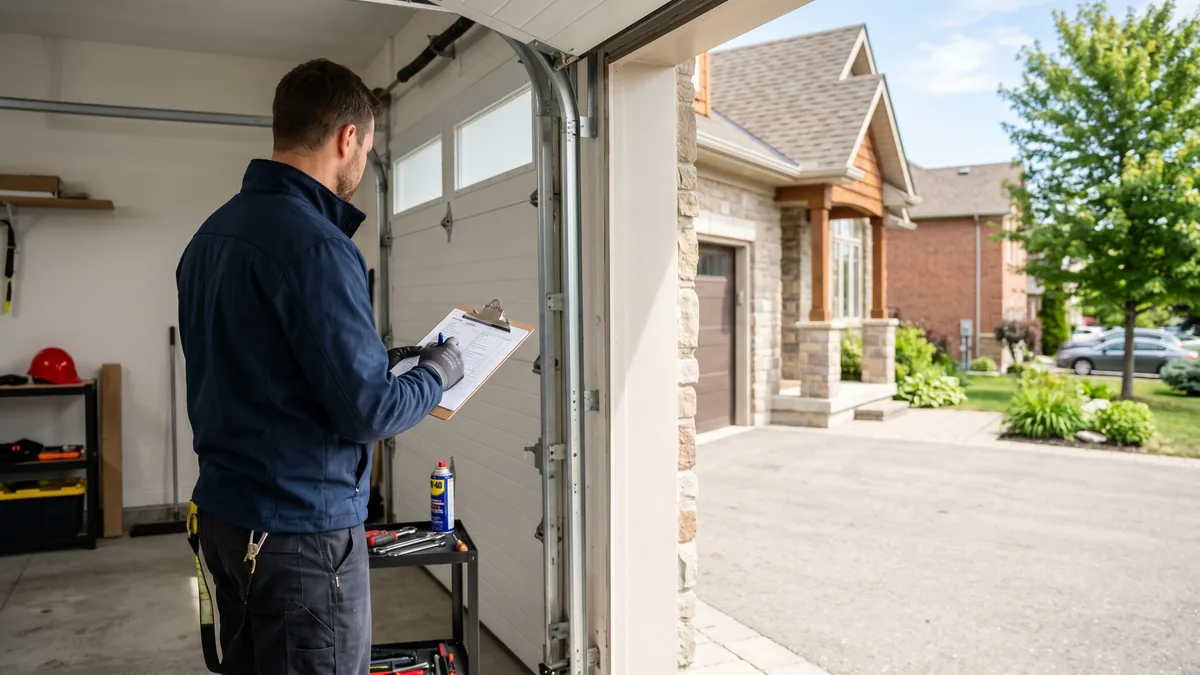
Service a residential garage door with a professional tune-up once a year. Between tune-ups, lubricate the rollers, hinges, and springs every 3–6 months, tighten the hardware twice a year, and test the auto-reverse safety feature monthly. Homes that open the door many times a day — or any commercial door — should be serviced two to four times a year because they wear out faster. A GTA tune-up runs $120 + tax.
What Is a Garage Door Tune-Up?
A tune-up is a scheduled inspection and adjustment of every moving part on the door — lubrication, hardware tightening, spring-tension and balance checks, cable and roller inspection, safety-sensor alignment, and an opener force test. It is preventive maintenance: the goal is to catch wear before a part fails and to keep the door operating safely and quietly between visits.
A garage door is the largest and heaviest moving object in most GTA homes, cycling more than a thousand times a year through Toronto’s brutal freeze-thaw winters. Yet most homeowners never touch it until something breaks. The single best way to avoid a $280 spring failure or a dead opener on the coldest morning of the year is a simple, predictable maintenance schedule. Here is exactly how often to service each part, what you can do yourself, and what costs to expect.
How Often Should You Service a Garage Door?
There is no single answer, because the door has parts that wear at very different rates. The opener gear, the springs, the rollers, and the safety sensors all have their own service intervals. The schedule below is the one I recommend to every customer across Toronto, Mississauga, and Brampton — it balances safety with cost and keeps the whole system in tune.
| Task | How Often | Who Does It |
|---|---|---|
| Visual look & listen test | Monthly | You |
| Auto-reverse safety test | Monthly | You |
| Lubricate moving parts | Every 3–6 months | You |
| Tighten hardware | Twice a year | You |
| Balance test | Twice a year | You |
| Professional tune-up | Once a year | Technician |
| Spring / cable inspection | Yearly (or at any warning sign) | Technician |
| Weather seal check | Yearly (before winter) | You / Technician |
How Door Usage Changes the Schedule
Frequency of use is the biggest variable. Garage door springs are rated in cycles — one full open and close is one cycle. A standard spring is rated for about 10,000 cycles. A two-car family that comes and goes four times a day racks up roughly 3,000 cycles a year, so a standard spring lasts only about three years before it is due to fail. The more you use the door, the more often it needs eyes on it.
- Light use (1–2 cycles/day): Annual tune-up is plenty. Springs may last 7–10 years.
- Average family (3–5 cycles/day): Annual tune-up; expect springs every 3–5 years.
- Heavy use or main entry (6+ cycles/day): Service twice a year and consider high-cycle springs.
- Commercial / multi-family: Quarterly service. See our commercial garage door repair and commercial maintenance guide.
The DIY Maintenance Schedule (Step by Step)
Routine upkeep is genuinely homeowner-friendly and takes about 30 minutes twice a year, plus a quick monthly safety check. Follow this order.
Monthly: The 2-Minute Safety Check
- Watch and listen. Run the door once. Note any new grinding, scraping, jerking, or sagging. A door that suddenly shakes or vibrates is telling you a part is wearing out.
- Test the reversal on contact. Lay a roll of paper towel flat on the floor in the door’s path and close it. The door must reverse the moment it touches the roll. If it does not, stop using the opener and call a technician.
- Test the photo-eye sensors. With the door closing, wave a broom through the beam near the floor. The door must reverse. Misaligned or dirty sensors are a common, cheap fix — $120–$180 if a part is needed.
Every 3–6 Months: Lubrication
Lubrication is the highest-value thing you can do for a garage door. Use a silicone-based or lithium garage-door lubricant — never WD-40, which is a degreaser that strips protection and attracts grit.
- Apply a light coat to each roller stem and bearing (nylon roller faces need none).
- Hit every hinge pivot where the panels fold.
- Lightly coat the torsion spring and the bearing plates at each end of the shaft.
- Wipe the inside of the tracks clean with a dry rag — do not lubricate the track surface itself.
- Run the door twice to work the lubricant in, then wipe away drips.
Twice a Year: Tighten & Balance
- Tighten hardware. From a stable ladder, snug every hinge screw, roller-bracket bolt, and track bolt with a socket wrench. Do not overtighten or you can strip the panel.
- Run the balance test. Close the door, pull the red emergency-release cord, and lift by hand to waist height. A balanced door stays put. If it slams down or springs upward, the spring tension is off — book a technician.
- Inspect cables and the bottom of the door. Look for frayed strands, rust, and worn rollers. Frayed cables are an early warning of failure.
What a Professional Tune-Up Includes
The yearly professional visit covers the high-tension and precision items that are unsafe or impractical to DIY. When a Royal Garage Doors technician performs a tune-up, the checklist looks like this:
- Spring tension & door balance — measured and adjusted so the opener is not overworked.
- Cable & drum inspection — checking for fraying, proper seating, and even winding.
- Roller & track inspection — flat spots, worn bearings, bends, and alignment.
- Full hardware torque — every fastener brought to spec.
- Opener force & travel limits — so the door stops and reverses correctly. See opener repair.
- Safety-sensor alignment and an auto-reverse test against the floor.
- Weather seal & threshold check — important before GTA winters; see side & top seals and threshold vs bottom seal.
- Lubrication of all moving parts with professional-grade product.
If your opener is more than 15 years old, a tune-up is also the right time to discuss whether it makes sense to replace it — modern units from LiftMaster, Chamberlain, and Genie add battery backup and smartphone control. We service every major brand, including Wayne Dalton.
What Does It Cost to Service a Garage Door in the GTA?
The annual maintenance package is inexpensive, especially next to the cost of a part that fails because it was never inspected. Here is current pricing across Toronto and the GTA (CAD, plus tax):
| Service | Typical Cost (CAD) |
|---|---|
| Maintenance & tune-up package | $120 + tax |
| Safety sensor repair / replacement | $120–$180 + tax |
| Weather seal (size dependent) | $120–$260 + tax |
| Cables & brackets | $180–$260 + tax |
| Single torsion spring | from $280 + tax |
| Double spring setup | $320–$460 + tax |
| New opener / motor | from $600 + tax |
The service call is FREE with any repair; a $120 diagnostic fee applies only if you choose not to proceed after the assessment. Repairs are backed by a 1-year labour warranty and 5-year hardware warranty. For complete, current numbers on every service see our pricing page, or compare a deeper repair against our spring replacement cost guide.
Tune-Up vs. Skipping Maintenance: The Real Math
Skipping service feels free, but it is the most expensive choice over the life of the door. A dry, neglected door wears its springs out years early, lets the opener grind itself to failure, and turns a $120 tune-up into a $280 spring plus an emergency call. A maintained door routinely lasts 15–30 years, and the opener and springs reach the top of their rated life instead of the bottom.
The Bottom Line
Book one professional tune-up a year, lubricate every 3–6 months, tighten twice a year, and run the safety test monthly. That simple rhythm prevents the large majority of broken springs, dead openers, and emergency calls we see across the GTA — and it costs about the same per year as a single tank of gas.
Due for a Garage Door Tune-Up?
Our IDEA Certified technicians service every brand of door and opener across Toronto & the GTA. Annual maintenance from $100, FREE service call with any repair, and same-day appointments available.
Call 437-265-9995Frequently Asked Questions
For independent safety guidance, see the U.S. CPSC garage door safety guide and the standards published by DASMA, the Door & Access Systems Manufacturers Association.