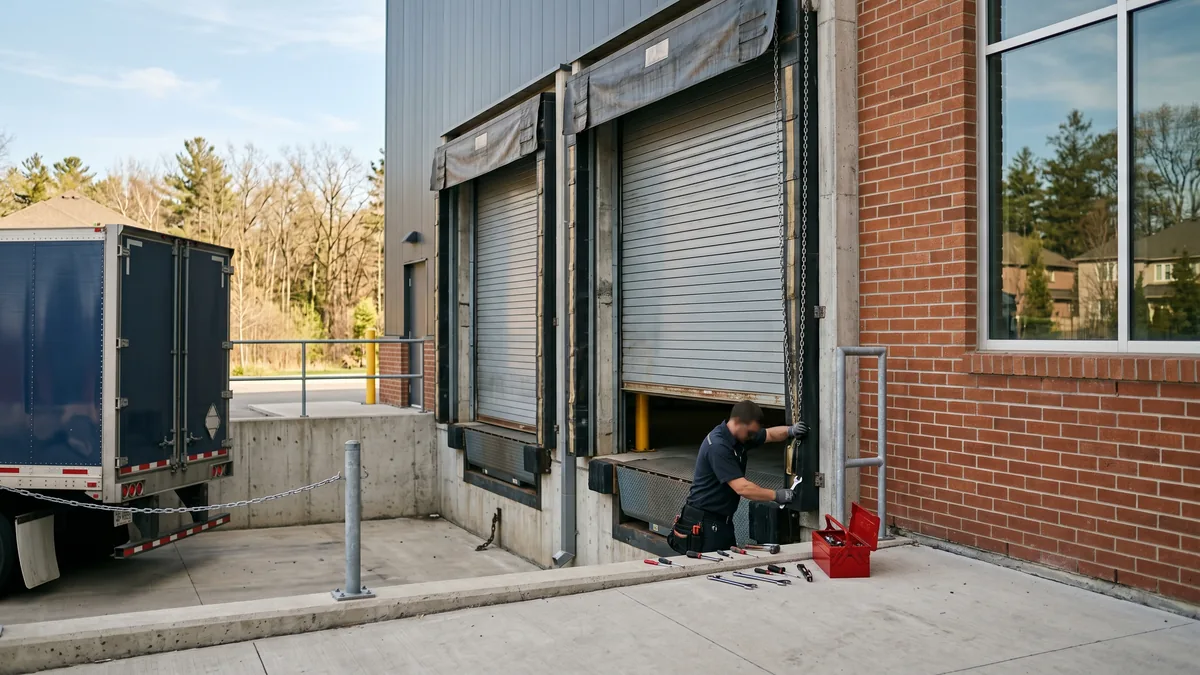
The four main loading dock door types are sectional steel doors, rolling (coiling) steel doors, high-speed fabric or rubber doors, and the dock seals and shelters that frame the opening. Sectional doors are the most common warehouse choice and offer the best insulation; rolling steel doors save headroom and resist abuse; high-speed doors cycle fast to control air and traffic; seals and shelters bridge the gap to the trailer. Most modern GTA docks combine an insulated primary door with a seal or shelter for efficiency through Canadian winters.
What Is a Loading Dock Door?
A loading dock door is the large commercial overhead door that closes the opening between a building’s shipping/receiving bay and the outside, where trailers back up to load and unload freight. Unlike a residential garage door, a dock door is engineered for heavy daily cycling, forklift traffic, weather sealing, and security — and it usually works alongside a dock leveler, bumpers, and a seal or shelter as part of one integrated loading system.
Choosing the right loading dock door is one of the highest-impact decisions a Toronto or GTA facility manager makes — it affects energy bills, worker comfort, freight throughput, and how often you call a technician. After 15 years servicing commercial docks across Mississauga, Brampton, and Hamilton, I have seen which door types thrive in our climate and which create costly headaches. This buyer’s guide breaks down every major type, the specs that matter, and how to match a door to your operation.
The 4 Main Loading Dock Door Types
Most commercial docks use one of four door families. They are not mutually exclusive — many high-volume facilities layer two together — but each starts from a different priority: insulation, headroom, speed, or sealing.
1. Insulated Sectional Steel Doors
Sectional doors are built from hinged horizontal panels that roll overhead along vertical and horizontal tracks, then store flat against the ceiling. They are the default choice for conditioned warehouses because polyurethane-injected steel panels deliver R-values around R-17 to R-18, the best insulation of any dock door type. They run quietly, seal tightly at the perimeter, and accept windows, vents, and pass doors. For most GTA distribution centres, an insulated sectional is the workhorse. If a forklift dents a panel, you can often do a single panel replacement rather than replacing the whole door.
2. Rolling (Coiling) Steel Doors
Rolling steel doors are made of interlocking metal slats that coil into a barrel mounted above the opening. Because they need almost no back-room or headroom, they suit tight mechanical rooms, low-clearance bays, and openings where a sectional door’s overhead tracks won’t fit. They are extremely tough, resist forklift and weather abuse, and offer strong security for exterior openings — which is why they dominate self-storage, parking structures, and industrial yards. The trade-off is lower insulation than a polyurethane sectional and slightly more noise. Our overhead door service page covers both sectional and coiling systems.
3. High-Speed Doors
High-speed doors use a lightweight fabric or rubber curtain that opens and closes at up to 80 inches per second or more — many times faster than a standard sectional. That speed minimizes air exchange every time the door cycles, which is critical for temperature-controlled rooms, food and pharmaceutical plants, and any opening cycled hundreds of times a day. They also self-repair after a forklift hits the curtain. High-speed doors are rarely the building’s outermost barrier; instead they often sit behind an insulated sectional, combining security and insulation outside with speed and traffic control inside.
4. Dock Seals & Shelters
Seals and shelters are not the door itself — they frame the opening to close the gap between the building and the docked trailer. Dock seals use foam pads the trailer compresses against, best for consistent trailer sizes. Dock shelters use adjustable fabric curtains or a head curtain, accommodating varied trailer heights and widths while allowing full-width door access. In our climate, a seal or shelter is the difference between a comfortable, dry dock and one fighting snow, ice, and skyrocketing heating bills whenever a truck is docked.
Loading Dock Door Comparison Chart
Use this side-by-side to see where each door type wins. The right answer depends on your priority — insulation, headroom, cycle speed, or budget.
| Door Type | Best For | Insulation | Headroom Needed | Cycle Speed |
|---|---|---|---|---|
| Insulated sectional | Conditioned warehouses, frequent cycling | Excellent (R-17 to R-18) | Standard | Moderate |
| Rolling steel | Tight headroom, security, abuse | Low to moderate | Minimal | Moderate |
| High-speed fabric | High traffic, climate-controlled rooms | Moderate | Standard | Very fast |
| Dock seal / shelter | Sealing trailer-to-building gap | N/A (works with door) | N/A | N/A |
Specs That Matter: Sizing, R-Value & Cycle Rating
Once you have chosen a door family, the details decide whether the door lasts five years or twenty. These are the specs I tell every facility manager to nail down before signing a quote.
Opening Size & Clearance
Standard dock openings are commonly 8’ or 9’ wide by 8’ to 10’ tall, but they vary widely. Measure the rough opening, the headroom above it, the side room on each side, and the back room (depth) for the door to store. Rolling steel doors need the least clearance; sectional doors need adequate headroom for the track radius. Getting these numbers right up front prevents the single most common installation surprise.
R-Value & Air Infiltration
In Ontario, insulation is not optional if you heat the space. Polyurethane sectional doors reach roughly R-17 to R-18; polystyrene-insulated doors land lower; non-insulated rolling steel offers minimal thermal resistance. Just as important is the perimeter and bottom seal — a high R-value panel with leaky weatherstripping still wastes heat. For more on how insulation pays back, see our insulated door energy savings guide.
Cycle Rating & High-Cycle Springs
This is where most dock door failures originate. A standard torsion spring is rated for about 10,000 cycles — roughly one to two years on a busy dock cycling 30+ times a day. High-cycle spring upgrades are discontinued; use standard torsion springs with scheduled inspections. For heavy daily traffic, use standard torsion springs with a documented inspection schedule; high-cycle upgrades are discontinued. Our deep dive on high-cycle springs for commercial doors explains the math, and how to measure torsion springs helps when ordering replacements.
What Loading Dock Doors Cost in the GTA
Commercial dock door pricing depends on size, gauge, insulation, motor, and cycle rating, so every opening is quoted individually. The figures below reflect typical Royal Garage Doors pricing in Toronto and the GTA (CAD, plus tax) to set expectations before an on-site assessment.
| Service | Typical Cost (CAD) |
|---|---|
| Supply & install — 15×7 or 16×7 double opening | from $2,300 + tax |
| Door only — delivery | from $850 + tax |
| Panel replacement (per section) | $500–$1,000 + tax |
| Cables & brackets | $180–$260 + tax |
| Per spring (commercial / multi-spring) | $160 / spring |
| Commercial maintenance / tune-up | $120 + tax |
| New commercial opener / operator | from $630 + tax |
Window inserts add $125 per window. High-cycle spring upgrades are discontinued; premium operators are quoted separately. For full current pricing on every service, see our pricing page, or compare detailed estimates in our garage door installation cost breakdown. The service call is FREE with any commercial repair or installation; a $120 diagnostic applies only if you choose not to proceed after the assessment.
How to Choose the Right Dock Door for Your Facility
There is no single best dock door — only the best fit for your operation. Work through these questions and the answer usually becomes obvious.
- Is the space heated or conditioned? If yes, prioritize an insulated sectional and a tight seal or shelter. Heating loss through a leaky dock is the biggest hidden cost in a GTA warehouse.
- How much headroom do you have? Limited clearance points to a rolling steel door that coils into a compact barrel.
- How many cycles per day? Heavy traffic requires frequent inspections of standard torsion springs and may justify a high-speed door to control air exchange and keep freight moving.
- What is the security and abuse exposure? Exterior openings in industrial yards favour rugged rolling steel; interior openings can use lighter high-speed curtains.
- What trailers dock here? Consistent trailer sizes suit foam dock seals; mixed fleets need an adjustable shelter.
- What is the budget over the door’s life? The cheapest door installed is rarely the cheapest to own. Insulation, standard torsion springs, scheduled maintenance, and a quality operator support reliable long-term operation.
Don’t Forget the Opener & Operator
Commercial dock doors use heavy-duty jackshaft or trolley operators rather than residential chain drives. Match the operator’s horsepower and duty cycle to your door weight and traffic. If an existing operator is failing, our opener repair service and the LiftMaster myQ setup guide help you keep a commercial system running. We service every major brand — including LiftMaster, Chamberlain, and Genie — without pushing a single manufacturer.
Industry Standards Worth Knowing
Commercial dock doors are governed by published standards from the Door & Access Systems Manufacturers Association. Their guidance on wind load, cycle testing, and safety is the benchmark serious manufacturers follow — you can review it at DASMA.com. For energy considerations specific to Canadian buildings, Natural Resources Canada publishes guidance at natural-resources.canada.ca.
Planning a Loading Dock Door for Your GTA Facility?
Royal Garage Doors supplies, installs, and services insulated sectional and rolling-steel dock doors across Toronto & the GTA. High-cycle spring upgrades are discontinued. FREE service call with any commercial repair or installation — same-day appointments available.
Call 437-265-9995